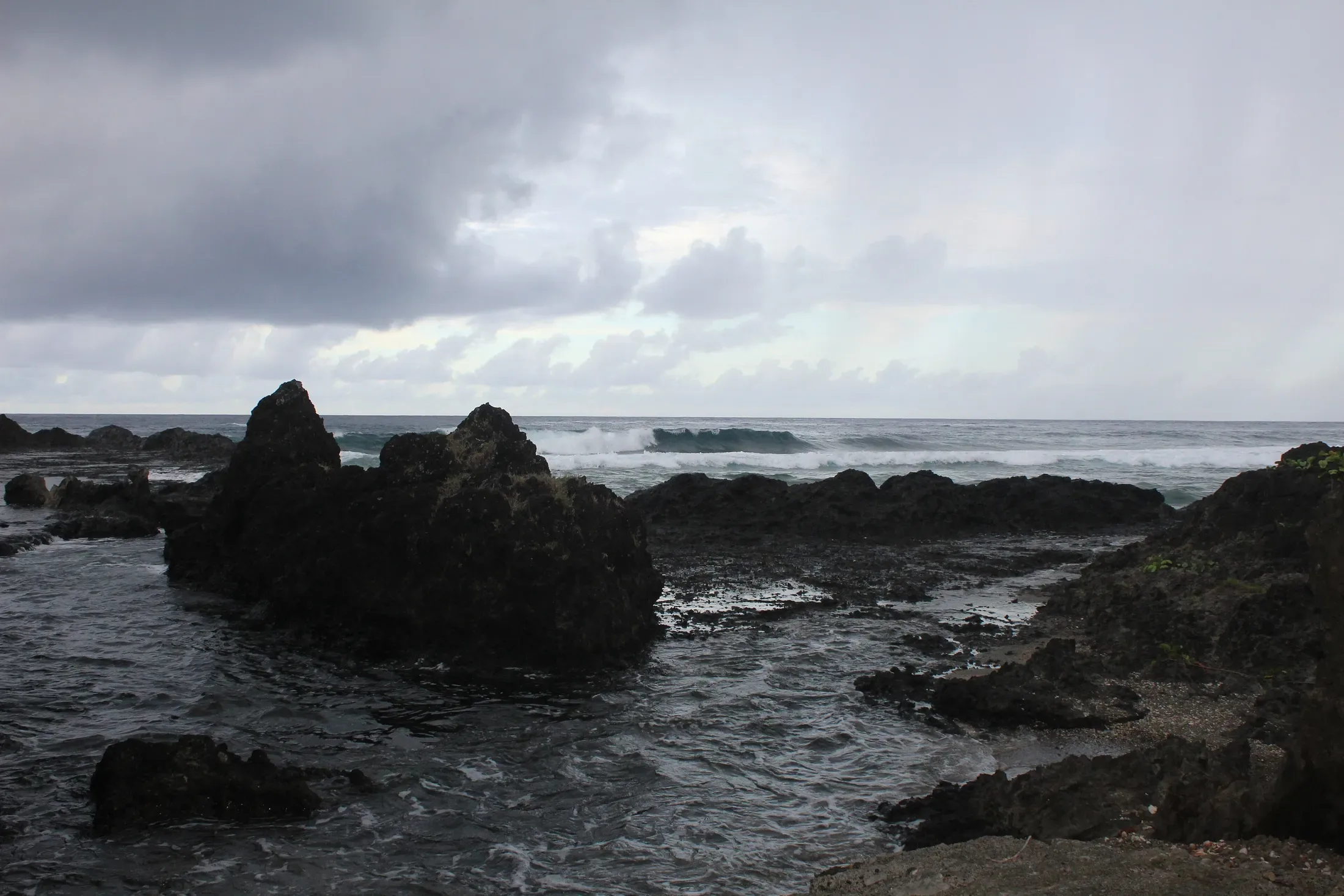
The Wallis and Futuna cyclone season runs from November to April, and the official tourism board rates the risk as low to moderate. Storms do reach the islands, so plan flexible dates, check flights before you travel, and carry insurance that covers local treatment and medical evacuation.
When to go ·
Wallis and Futuna cyclone season: dates, risk and planning
Wallis and Futuna cyclone season runs November to April, with risk rated low to moderate. Past storms, what to plan for, and where the records are silent.
01
Cyclone season dates
The tourism board gives the cyclone period as November to April and describes the risk as low to moderate. It also describes a tropical maritime climate with no dry season: temperatures of 22 to 32 °C and more than 3,000 mm of rain a year, so rain is possible at any time, and not only in cyclone months.
If you searched for the hurricane season in Wallis, note that in the South Pacific the same storms are called tropical cyclones. A French search for the saison cyclonique at Wallis will lead to the same November to April window.

02
What past storms did
The records give several examples, and they show that effects vary by storm and by island. Cyclone Ofa, in February 1990, passed about 240 km east of Wallis. A storm surge of about one metre flooded the east coast and residents were evacuated, but damage was minor and nobody died.
Cyclone Tomas, on 14 and 15 March 2010, was a category 4 storm. There were no deaths among inhabitants, but it caused heavy damage to homes, crops and public facilities, mostly on Futuna. Since Tomas the main coastal road has been cut at Pointe des Pyramides on Futuna.
Cyclone Tino, on 17 and 18 January 2020, hit Wallis hardest: downed trees, flooded roads, damaged homes and power cuts, with no deaths reported. Aircalin inter-island flights were cancelled. Cyclone Evan in 2012 damaged the Lausikula chapel on Wallis, which was rebuilt and blessed on 26 September 2014.

03
When to go instead
Cyclone season runs from November to April, so travel outside those months avoids it, although the tourism board describes the climate as having no dry season.
Several dates fall within the season and are worth keeping in mind. The pilgrimage to Poi on 28 April, Saint Pierre Chanel's day, draws about 1,000 pilgrims, so book early if you plan to be there. Territory Day on 29 July and Bastille Day on 14 July fall outside the cyclone months.
04
Planning and flexibility
Cyclone risk is mostly a scheduling problem for a visitor. Check your flight status before you travel, because a cancellation can mean a delay. Inter-island flights do not run on Sundays, and there is no public sea crossing between Wallis and Futuna. Leave a buffer at both ends of your trip, and avoid tight onward connections.
Where you can, choose bookings that allow changes, and ask your accommodation about its policy before paying. The records do not state any hotel's cyclone or cancellation policy, so we cannot tell you what each one offers.
05
Insurance and safety
We have no cyclone-specific insurance guidance. The UK government advises travellers to take insurance covering local treatment and medical evacuation, which is sensible at any time of year because serious cases are usually evacuated to Nouméa. Read your policy for storm-related cancellation and delay, and ask your insurer, not us, about what it covers.
For live warnings, rely on official local sources and the tourism office instead of this page.
06
Onward travel in the region
If you are combining Wallis and Futuna with neighbours, note that their seasons overlap. Fiji's cyclones can occur from November to April, Tonga's cyclone season runs from 1 November to 30 April, and Samoa's rain and cyclones fall between October and March, according to community and encyclopaedia sources.
Questions people ask.
- When is cyclone season in Wallis and Futuna?
- The tourism board gives November to April. It rates the risk as low to moderate, but storms have still caused damage in the past, so allow for flexibility.
- Has Wallis and Futuna been hit by cyclones?
- Yes. Records describe Ofa in 1990, Tomas in 2010, Evan in 2012 and Tino in 2020. Tomas hit Futuna hardest and Tino hit Wallis hardest. The records report no deaths among inhabitants in Ofa, Tomas or Tino.
- What is the best time to visit Wallis and Futuna to avoid cyclones?
- Cyclone season runs November to April, so travelling outside those months avoids it, though rain is possible at any time of year.
- Do cyclones affect flights to Wallis?
- They can. Tino led to cancelled inter-island flights in 2020. Build in spare days and check with Aircalin before you travel.
Stay on the islands with IMPT.
IMPT (impt.io) is the booking platform behind this site: 8 million hotels and apartments across 195 countries, including the Pacific neighbours of Wallis & Futuna. Stays on Wallis and Futuna themselves are arranged by enquiry with each host. Every stay booked through IMPT supports climate action through the IMPT Climate Contribution programme.
Read next.
The invitation starts here
Be part of the
next chapter.
Join the waitlist First access to stays, routes and launch news.
No spam. Unsubscribe any time.