The islands
Futuna and Alofi.
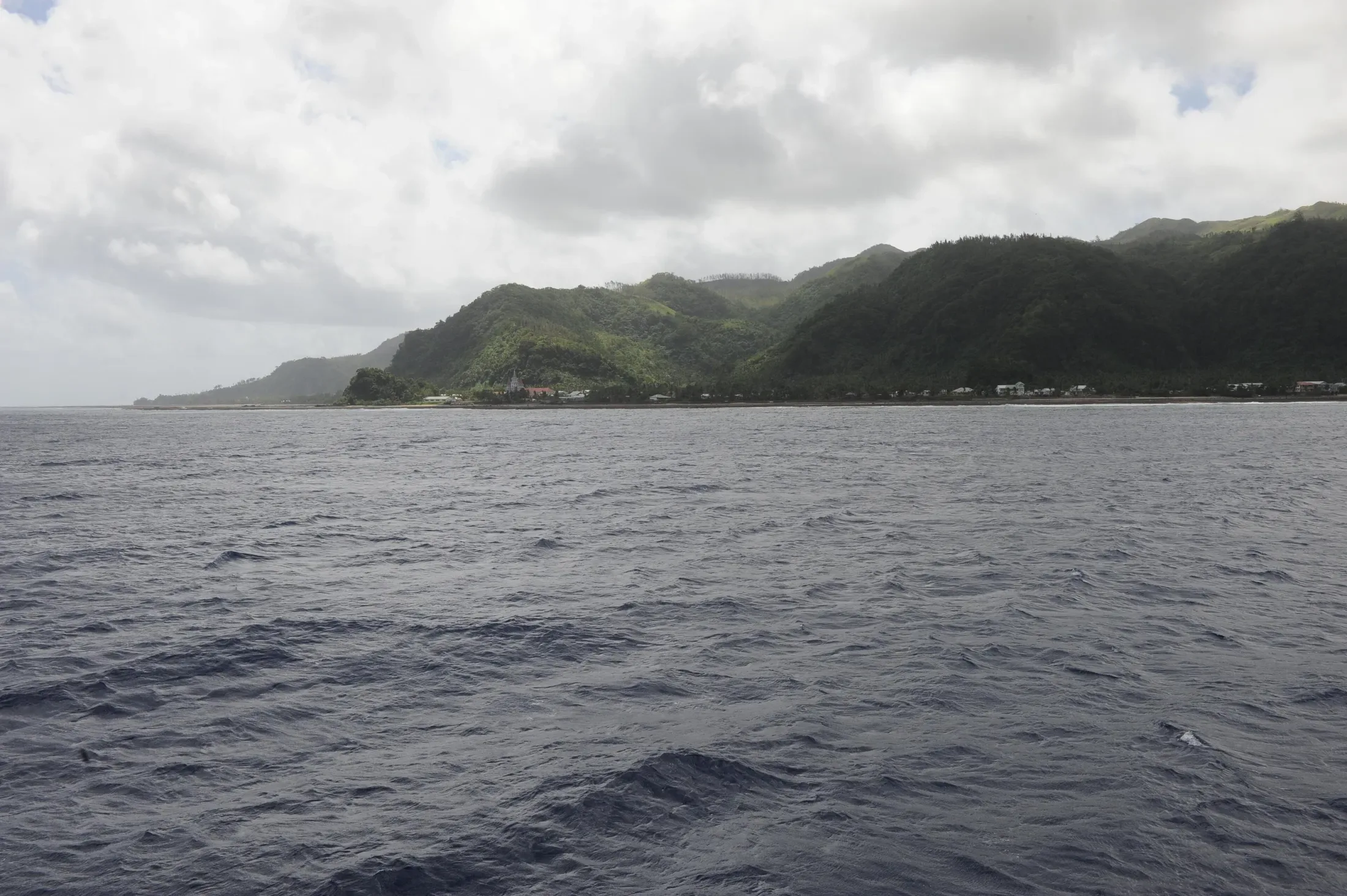
Two mountainous islands, once one volcano, facing the open ocean across a channel under two kilometres wide.
Read onFar to the southwest of Wallis, the Hoorn Islands lie to the southwest of Wallis. Futuna is the green, mountainous, inhabited island; Alofi, its neighbour across a narrow channel, is the quiet one. Here there is no lagoon, only reef, rock, taro gardens and the long habit of custom.
- Area
- About 64 km2 (Futuna and Alofi together)
- Inhabitants
- 3,063 on Futuna (2023 census)
- Kingdoms
- Sigave and Alo
- Highest point
- Mont Puke, 524 m
- Home language
- Futunan, 94.5% in Futuna (2018)
- Airport
- Pointe Vele, in Alo
01
Two islands, one old volcano
Futuna and Alofi are remnants of the same extinct volcano, and together they are about 64 square kilometres. The channel between them is under two kilometres wide.
Futuna has large lava flows from the Upper Pliocene, together with breccia and hyaloclastite from underwater eruptions, and it lies on a zone where the Pacific and Australian plates interact.The island is mountainous, and the sea is close to the slope.

02
Two kingdoms: Sigave and Alo
Futuna has two customary kingdoms. Sigave occupies the northwest, and its king holds the title Tu'i Sigave; its capital is Leava. Alo covers the southeast and Alofi, and its king holds the title Tu'i Agaifo. Alo has nine villages and Sigave has six.
In each kingdom the king is assisted by five ministers, the Aliki Fa'u, and a police chief. Custom, called Aga'ifenua, is central to daily life. Anthropologists consider the word king an imperfect translation of the Futunan titles sau and hau. Each king oversees cultural and religious matters and rituals, and holds customary authority over land use. A fono, a council, handles civil and customary justice.

03
Leava, and the one gap in the reef
Futuna has no lagoon, and the reef that rings the island has a single break, opposite a river estuary. That break gives safe anchorage at Leava, the capital of Sigave. Leava Bay is the most sheltered on Futuna, and visiting yachts report first to customs at the quay.
At Leava a cross marks the place where Pierre Chanel landed in 1837. In the harbour the boats for sightseeing and fishing trips leave from the Leava quay, and it is also where a visitor can learn to row a va'a with Avamoana Va'a.

04
Mountains and coast
Mont Puke, at 524 metres, is the highest point of the territory. The climb is described as demanding and suited to experienced hikers, with wide views as the reward. The mountain is said to be the refuge of Finelasi, the goddess who protects Futuna.
The fringing reefs are 50 to 100 metres wide and the coast is rocky and volcanic. Roads are poorer than on Wallis, with dirt tracks to key sites, and since Cyclone Tomas the main coastal road has been cut at Pointe des Pyramides, which is also a sunset stop on the board's Futuna tour. Tuatafa in the far north has black volcanic sand, a natural pool and sunsets.

05
Poi and Saint Pierre Chanel
Futuna is a place of pilgrimage. Pierre Chanel landed here in November 1837, and he was killed on 28 April 1841. He was beatified in 1889 and canonised on 12 June 1954, and is described as the first martyr and patron saint of Oceania. His killer, Musumusu, later converted and asked to be buried outside the church at Poi, so that those venerating Chanel would walk over his grave.
The basilica at Poi holds two silver reliquaries with Chanel's skull and bones. Around 28 April, his feast day, worshippers come from across the Pacific, and the tourism office head puts the pilgrims at about a thousand. The day is a public holiday in the territory.

06
Alofi, the quiet island
Alofi is reached by boat; the taxi boat of the Association Vele leaves from Vele. It has no natural fresh water, which is given as the reason it is virtually uninhabited. Its highest point is Mt Kolofau.
On the board's tour you will find Alofitai beach, the first freshwater well, the Sacred Heart chapel and the hot springs of Vaivevela. Loka Cave is a pilgrimage site for Futunans and a source of fresh water; it was blessed on 3 December 1952 and holds a statue of the Virgin and an altar, and a pilgrimage is made there on 11 February. Alofi is also a BirdLife Important Bird Area, with a colony of red-footed boobies and the vulnerable shy ground dove.

07
Life in the fale
Traditional fale on Futuna are wood-framed with thatch of coconut or pandanus leaves. In every village there is a fale tauasu, a meeting house where the men gather each evening to drink kava and settle local matters. Women are excluded from the kava on Futuna, but they may watch.
The beaches in front of houses belong to the owner, so ask or introduce yourself first. A Futunan citizen of a village holds the status of fatogia, which brings rights and duties, including taking part in katoaga. Taro from the taro patches is eaten mainly at customary or religious events.

08
Fishing and gardens
Roughly 80 per cent of the labour force in the territory works in subsistence farming, livestock or fishing, which tells you how much of daily life on Futuna still comes from the sea and the garden. Local produce, such as sweet potato, cassava and yam, is grown without imported fertilisers or pesticides.
The Futuna speciality foods include pakanuku, the water taro, along with coconut crabs and lobsters. Visitors at a village or district festival may share a meal prepared by the villagers.

Next, read how these islands came to be settled, charted, converted and, in the end, joined to France.
Enquire about your visitThe invitation starts here
Be part of the
next chapter.
Join the waitlist First access to stays, routes and launch news.
No spam. Unsubscribe any time.