Culture
Custom, kava and song.
Here the old order is not performed for visitors; it is simply how a feast, a funeral or a coronation is done.
Read onWallis and Futuna are Catholic islands with living kingdoms, and the two facts shape everything: the order of a feast, the gift of a mat, the way a bowl of kava is passed. A visitor does best to arrive as a guest, to ask before photographing, and to let the day unfold in its own order.
- Religion
- About 99% Catholic
- Languages
- French, Wallisian, Futunan
- Territory Day
- 29 July
- Dance types
- At least 16 faive
- Customary kingdoms
- Uvea, Sigave, Alo
01
Kava
Kava is made from the root and branches of a plant of the pepper family and prepared in a wooden bowl called a tanoa. It is always performed at the enthroning of a customary king, and it is part of all religious rituals and customary offerings. According to the tourism board, only men grow and prepare it.
The order is strict. On Wallis the first cup goes to the Lavelua and the last to the Prefect, with cups alternating between nobles, the 'aliki, and commoners, the tu'a, by rank. Those who receive a cup clap three times. On Futuna everyone present claps when the king drinks. Talking, smoking and moving are forbidden during the kava, and all observers sit; customary guards will point out any faux pas.

02
The evening house
In Futuna each village has a tauasu house where men gather each evening to drink kava and settle local matters. The Wallisian equivalent is the faikava. In Futuna women are excluded from the kava ceremony but may watch; on Wallis, women of certain rank may take part.
A community guide, which you should confirm locally, advises that you remove your shoes before stepping on the mats of a fale tauasu, sit and wait to be introduced, and finish the whole shell.

03
The katoaga
The katoaga is a customary festival at which goods are exchanged: pigs, yam and taro baskets, mats, tapa and envelopes of money. It marks religious feasts, territory holidays, enthronements, weddings, first communions and funerals. One anthropologist, quoted in a source, compares the gift and counter-gift to a potlatch and calls it not folklore for tourists.
At a Wallis katoaga the order is early mass, a meal for dignitaries, kava, dances and then distribution of the food by rank. The larger pigs go to the higher ranking, and the shares are announced aloud in descending order. Katoaga dates are set by custom, not fixed in advance, and none are scheduled for tourists.

04
Territory Day
The territory celebrates 29 July as Territory Day, the anniversary of the law of 1961. On that day, and on Bastille Day, 14 July, a kava ceremony, dances and a mass take place that visitors can join. At large festivities such as these kilikiti is played, the Wallisian cricket and the archipelago's emblematic sport.
Kilikiti has one wicket where cricket has two, and the stump distances, the throwing technique, the number of players and the field boundaries are decided the day before by the captains and judges. On the eve of a match each team invokes protective spirits, and village groups visit the 'aliki around midnight with kava for advice and blessing.

05
Dance
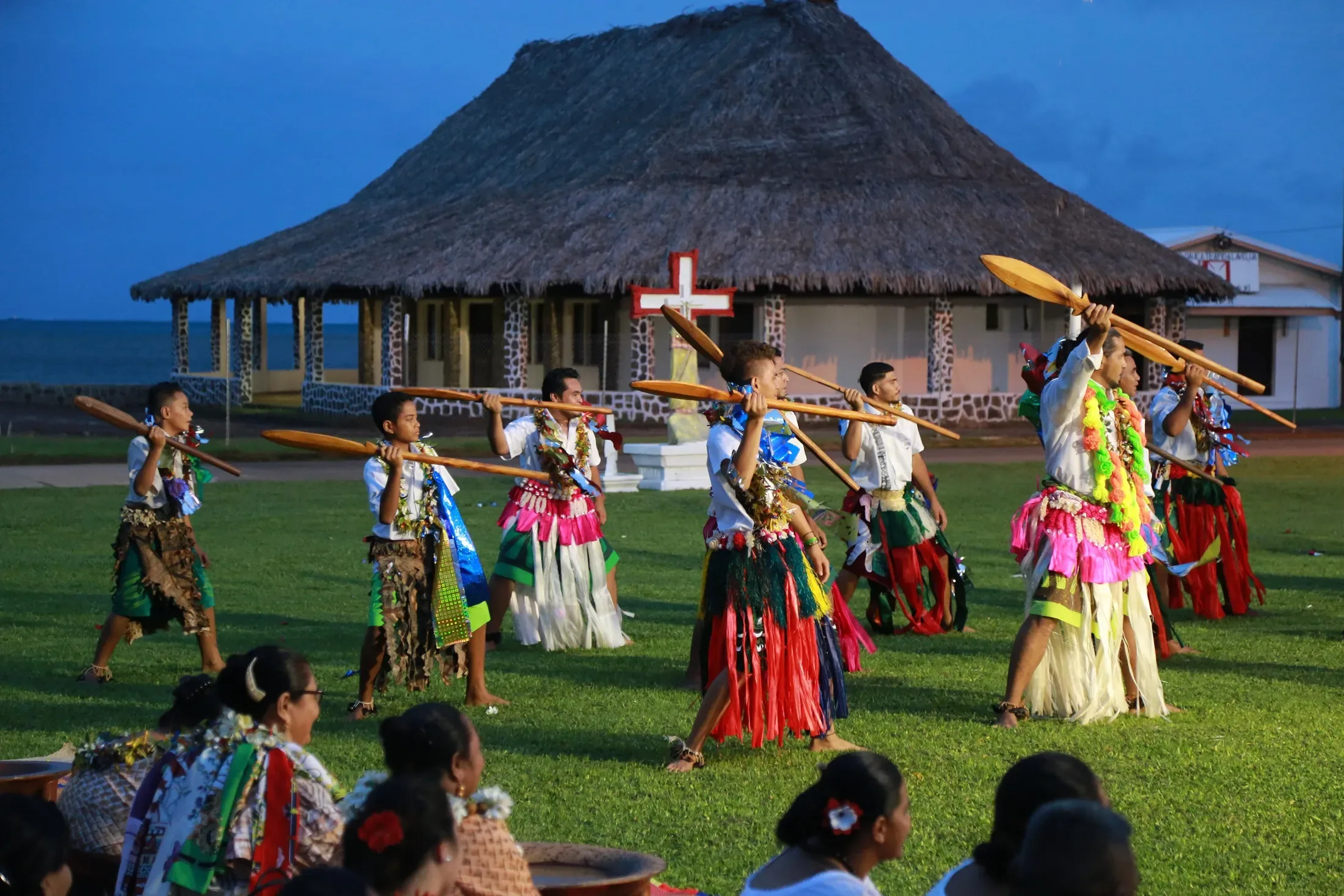
There are at least sixteen types of dance, called faive, varying with the place, the occasion, the performers and the instruments. Most include singing and percussion, but the kailao has no song. In the kailao two groups of men approach each other from opposite sides of the mala'e with clubs. The tapaki is a paddle dance honouring a chief and ancestors, said to have originated in Futuna. The eke is a stick dance performed in pairs, the sasa is a seated dance borrowed from Samoa, and the soamako is an informal dance that accelerates, with a chorus, drums, guitars, ukuleles and the nafa.
Spectators reward dancers with banknotes, and money placed in headdresses is pooled and shared. On 15 August dancers perform at the Assumption festival.

06
Tapa and pandanus
Giant tapa is called gatu in Wallisian and siapo in Futunan, and it is made by women. It is made from the bark of the paper mulberry, called tutu, beaten, soaked, dried, cut and hand-painted, and it is offered at customary and religious ceremonies. Cloths can be 100 metres or more, needing days of work by many women. Mats, called fala, are woven from lau akau and laukie leaves.
The ta'ovala, a waist cloth, is worn only on Wallis, at customary and religious ceremonies or when presenting to the king. Tiare flower necklaces signal welcome.

07
Faith and the church
About 99 per cent of the population is Catholic. Feast days and large occasions always include mass, and any major religious feast follows the same pattern: mass, then kava, then katoaga gift-sharing, then dances. Among the dates to know are 28 April, the day of Saint Pierre Chanel, with pilgrimage to Poi; 1 May, the parish feast of Saint Joseph at Mala'efo'ou and Nuku; and 28 August, a pilgrimage at the Chanel chapel on Mont Mauga.
On Mount Holo the island's only Carmelite convent chapel, moved there in October 2005, is home to about a dozen nuns. Visitors should remove hats in churches and dress appropriately; a guide suggests covering shoulders and knees, which is worth confirming locally. The Territorial Department of Cultural Affairs can advise about customs.

08
Three languages
French is the official language, but at home the islanders speak Wallisian, Futunan and French, in 2023 at 57.3, 28.2 and 14.3 per cent. Few islanders speak English, though tourism professionals mostly do, so some French is strongly advised.
Wallisian, or Uvean, is closely related to Tongan and has borrowed heavily from it, and it has honorific, commoner and vulgar registers. A common greeting is Mālō te maʻuli, often written without macrons. Futunan, closely related to other Western Polynesian languages, is classed as endangered, with about 2,500 native speakers in the territory in 2018; its decline is tied to the large migration to New Caledonia after the Second World War.

09
Chiefs and the customary order
Beside the French state stand three customary kingdoms, Uvea, Sigave and Alo. The Lavelua is assisted by a prime minister, customary ministers and village chiefs, the faipule and the pula kolo. Kingship is not simply inherited; royal families negotiate, sometimes over months. Each king oversees cultural and religious matters and holds customary authority over land use.
For a visitor the practical rules are simple. Beaches in front of houses belong to the owner, so ask or introduce yourself first. Ask before photographing people, because photography is often prohibited at traditional ceremonies. And remember that a Wallis and Futuna festival is held annually in Nouméa.

A feast always ends at the table, so turn next to the earth oven.
Enquire about your visitThe invitation starts here
Be part of the
next chapter.
Join the waitlist First access to stays, routes and launch news.
No spam. Unsubscribe any time.