Getting there
Getting there.
A long way from almost everywhere, and reached by two small airports.
Read onWallis and Futuna sit about 2,500 kilometres from Nouméa and 780 from Suva, so the journey is part of the story. This page sets out only what is firmly known. Schedules, fares and frequencies change, and none are given here; confirm everything with the airline and the Tourist Office before you plan.
- Currency
- CFP franc (XPF), pegged to the euro
- Electricity
- 220 V, French-type sockets
- Main airport
- Hihifo (WLS), Wallis
- Languages
- French, Wallisian, Futunan
- Climate
- 22-32 C; cyclone season November to April
01
Where in the world
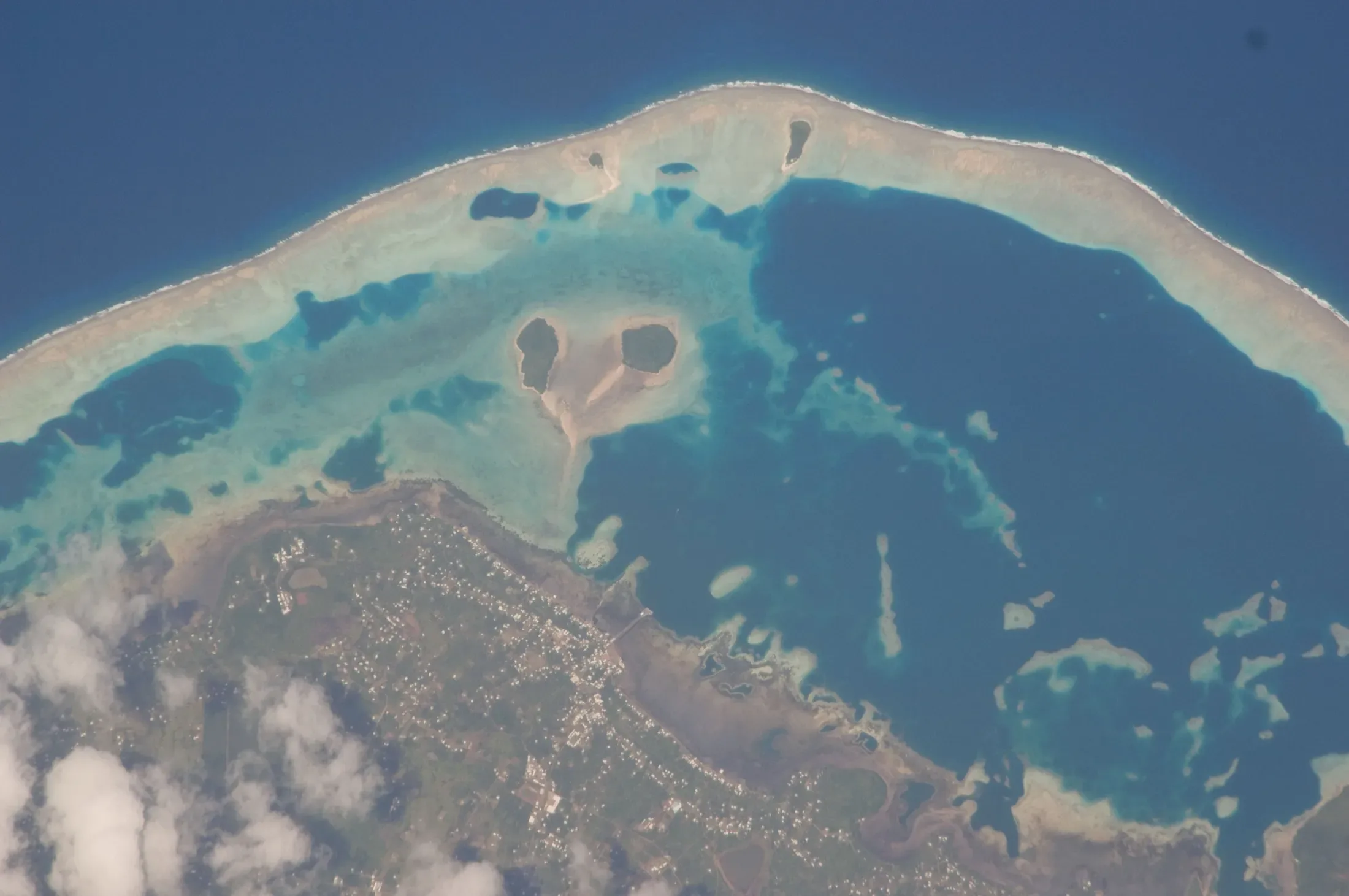
The territory has two island groups, Wallis in the northeast and the Hoorn Islands of Futuna and Alofi in the southwest, roughly 230 kilometres apart. In total they cover about 142 square kilometres. The official statistics sheet puts Paris at 16,000 kilometres, Suva at 780 and Nouméa at 2,500.
Fiji lies about 280 kilometres from Futuna, and Samoa about 370 kilometres from Wallis. Those are the near neighbours across the water. Direct links from Wallis to them have not been confirmed here, so confirm any route with an airline or operator before you plan around it.

02
Landing on Wallis
The main gateway is Hihifo Airport, on Wallis, with a 2,100-metre asphalt runway. Airline listings show Aircalin services to Nouméa and Nadi. The Hihifo bomber airfield became operational in October 1942, and is today's airport.
There is no exchange office at Hihifo, so exchange your money before you arrive. The car-hire firm Haviti Location has a desk at the airport.

03
The hop to Futuna
Futuna's airport is Pointe Vele, at Vele in Alo. There is no public sea crossing between Wallis and Futuna, so the link between the two groups is by air. Inter-island flights do not run on Sundays, and the schedule must be confirmed before you plan around it.
Futuna's roads are poorer than those of Wallis.

04
Passports and French status
The territory is a French overseas collectivity, so arrival documents are as for France. Non-EU passengers need a passport, and many nationals need no visa; check France-Visas. UK nationals can travel visa-free for up to 90 days for business or tourism, with a passport valid for six months after departure. A yellow fever certificate is required if you arrive from a transmission-risk country.
Customs rules are strict, so declare anything prohibited or dutiable. The rules for other nationalities may differ, so check the official sources before you book.

05
Money, power and the phone
The currency is the CFP franc, pegged to the euro. Many shops lack card terminals, and there is no exchange office at Hihifo or Vele airports. The only retail bank is the Bank of Wallis and Futuna, with three cash machines on Wallis and two on Futuna.
Electricity is 220 volts with French-type sockets. Mobile coverage is the Manuia 4G network, SIM cards are sold at SPT offices, and calling the territory from France uses 00 681. The islands are described as safe and almost free of crime.

06
Languages and getting about
French is the official language, and some French is strongly advised. Wallisian, Futunan and French are all in daily use. Few islanders speak English, though tourism professionals mostly do.
There is no public transport and no taxis, so a hire car is needed, and traffic drives on the right. Hire firms are listed in Mata'Utu, at Liku, at Mua and Aka'aka on Wallis, and at Sigave and Alo on Futuna. Access for reduced-mobility visitors is limited.

07
When to come
The climate is tropical maritime, warm and humid, from 22 to 32 degrees Celsius, with rainfall over 3,000 millimetres a year. The average temperature is about 26.6 degrees and humidity near 80 per cent. Cyclone season runs from November to April, with risk rated low to moderate by the tourism board.
Dates for festivals are set by custom, and the 2026 programme is not confirmed, but fixed public holidays include 28 April, 14 July and 15 August. About a thousand pilgrims come around 28 April, according to the head of the tourism office. Ask the Tourist Office before you choose your dates.

08
What to pack, and what to insure
A guide advises covering shoulders and knees at church and covering swimwear near villages, which is worth confirming locally. Take a hat you can remove at the door of a church. Change money before you arrive and carry cash, because card terminals are not widespread.
Take insurance covering local treatment and medical evacuation. The SIA hospital serves Wallis and the Kaleveleve hospital serves Futuna, and serious cases are usually evacuated to Nouméa. The emergency number from a mobile is 15. Remember, too, that kava cannot be taken home to metropolitan France.

A PACIFIC PASSAGE
Find your starting point.
Coming · announced / planned
- Nadi → Wallis / Uveaplanned
- Wallis / Uvea → Futunaplanned
Check with the airline for current schedules.

Your island concierge
The practical guide.
Entry and documents, money and payments, connectivity, getting around, flying in and between the islands, and arriving by sea — the practical detail for Wallis and Futuna, each point from its source.
Entry & documents
The territory is a French overseas collectivity; arrival documents are as for France, non-EU passengers need a passport, and many nationals need no visa (check France-Visas).
SourceUK nationals: visa-free up to 90 days for business or tourism; passport must be valid 6 months after departure.
SourceA yellow fever certificate is required if arriving from a transmission-risk country.
SourceCustoms rules are strict; declare anything prohibited or dutiable.
Source
Money & payments
Connectivity & power

Getting around

There is no public transport and no taxis; a hire car is needed, and traffic drives on the right.
Source
Flying in & between the islands
Hihifo Airport (WLS) has a 2,100 m asphalt runway; airline listings show Aircalin services to Nouméa and Nadi.
SourceFutuna's airport is Pointe Vele (Vele, Alo).
SourceThere is no public sea crossing between Wallis and Futuna; inter-island flights do not run on Sundays (confirm before showing schedules).
Source
Arriving by sea

Yachts must report first to customs at the quay (Mata'Utu, Leava) then the gendarmerie; Gahi Bay is the only authorised anchorage on Wallis and Leava Bay the most sheltered on Futuna.
Source
Good to know

When to go
The islands, through the seasons.
The season, the cyclone record, and where the islands' tourism is heading by 2030.
The season
Cyclones on record

Cyclone Ofa (February 1990) passed about 240 km east of Wallis; a storm surge of about 1 m flooded the east coast, residents were evacuated, damage was minor and there were no deaths.
SourceCyclone Tomas (14-15 March 2010, category 4) caused no deaths among inhabitants but heavy damage to homes, crops and public facilities, mostly on Futuna.
SourceCyclone Tino (17-18 January 2020) hit Wallis hardest: downed trees, flooded roads, damaged homes, power cuts, and no deaths reported.
Source
Visitor numbers & the 2030 plan

The tourism office head estimates about 6,000 tourists a year in 2026, about 2,000 around 2019, with a target of 10,000 a year by 2030 (office estimate, interview of August 2026).
SourceThe same interview cites about two cruise ships and about 50 yachts a year, around a hundred trails and about fifteen accommodation offers (hotels and homestays).
SourceMain source markets are New Zealand, Australia, New Caledonia and metropolitan France.
SourceThe territory's plan is to limit cruises (about 2 ships a year, draft 6 m or less, 200-300 passengers), develop homestays and secure hiking trails, with no luxury hotel projects.
Source
Once you know how to arrive, look at where you might sleep.
Enquire about your visitThe invitation starts here
Be part of the
next chapter.
Join the waitlist First access to stays, routes and launch news.
No spam. Unsubscribe any time.