The islands
Wallis, called Uvea.
A low volcanic island inside a ring of reef, with a king, a blue stone cathedral and lakes that sit in old craters.
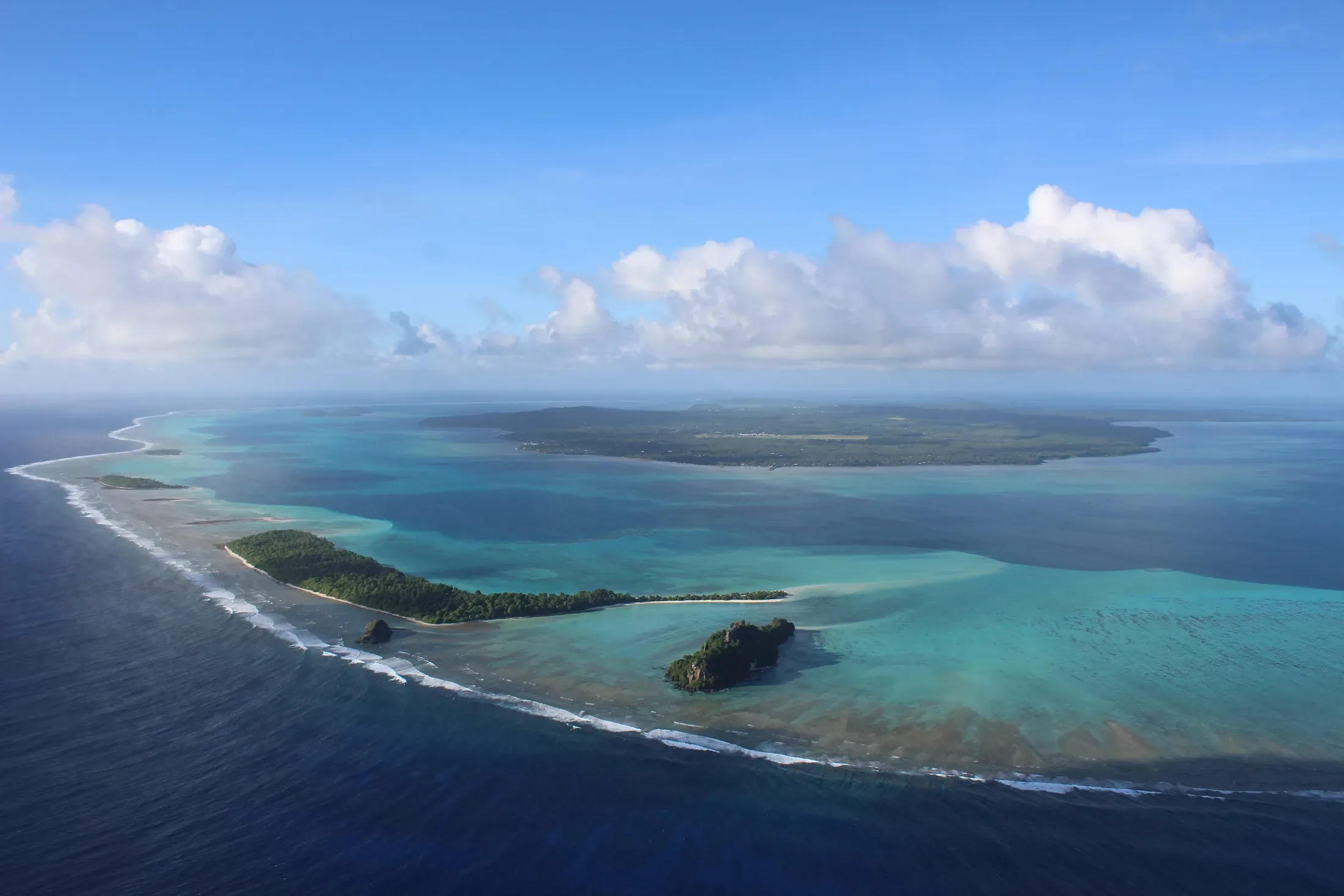
Read onWallis, which its people call Uvea, is the northeastern island of the territory and the larger of its two main islands. Seen from the air it is a green island held inside a pale ring of lagoon and reef.
- Area
- About 77 km2
- Inhabitants
- 8,088 (2023 census)
- Capital
- Mata'Utu
- Villages
- 21, in three districts
- King's title
- Lavelua
- Highest point
- Mont Lulu, about 150 m
01
An island inside a ring
Wallis is about 77 square kilometres, and it is encircled by a lagoon and a barrier reef. The reef is four to five kilometres wide, with about 220 square kilometres of coral. Together with the Hoorn Islands of Futuna and Alofi in the southwest, Wallis makes up the three main volcanic islands of the territory.
A drive round the coast is about 35 kilometres. Wallis has no snakes or dangerous predators, according to the tourism board.

02
The lagoon and its islets
Inside the reef lies a lagoon that holds more than a dozen uninhabited islets, called motu. All of them sit on the eastern side of the reef. The passes through the reef are on the west and south, and only the Honikulu pass in the south takes large ships.
Visitors reach the motu by taxi boat, or by kayak from the Vakala watersports centre at Liku. Before you go, check with the Tourist Office about protected areas and rules.

03
Mata'Utu, the capital
Mata'Utu is the capital and main port of Wallis. Here you will find the wharf, the blue volcanic-stone cathedral and the museum of the Uvea Museum Association, which is dedicated to the war years on Wallis. Halalo has the fuel depot, and Gahi Bay is the only authorised anchorage on the island.
Beside the taxi-boat pier at Gahi you will find the restaurant La Paillote, a va'a base and the small Chapelle de Gahi.

04
The kingdom and the Lavelua
Wallis is the kingdom of Uvea, one of three customary kingdoms in the territory. Its king holds the title Lavelua, and its capital is Mata'Utu. The Lavelua is assisted by a prime minister, the Kalae Kivalu, by customary ministers and by village chiefs. The kingdom was founded in the 15th century.
The crown is not simply handed from father to son. Royal families negotiate the choice, sometimes over months. When Tomasi Kulimoetoke II, the 50th Lavelua, died in 2007, a six-month period of mourning followed, during which it was taboo to mention a successor.

05
Villages and districts
Uvea has 21 villages in three districts: Hihifo, Hahake and Mu'a.
At the northern tip, Vailala is a fishing village with fine white sand and a name as a sunset spot. In Hahake, Falaleu looks out over the lagoon. In Mua, Liku is home of the Vakala watersports centre and Halalo has a dive centre.

06
The crater lakes
Wallis has no streams. Its fresh water comes from crater lakes, left behind by volcanic activity, and they are the island's main reserves. Four are named: Lalolalo, Lanutavake, Kikila and Alofivai.
Lalolalo is the largest lake in the territory, in the southwest of Wallis off Route 1 between Mala'etoli and Ahoa. It is a near-circular crater roughly 400 to 500 metres across and at least 80 metres deep, with sheer rock walls. Fresh at the top, it is salty at the bottom with no oxygen below ten metres. A lookout gives a view of the whole lake, and flying foxes and tropical birds live in the forest around it. Lalolalo also figures in local mythology.
Kikila is smaller, about ten and a half hectares. Around Lalolalo the forest was once regarded as sacred, a vao tapu; during the Second World War a road was cut through it, and American forces later disposed of equipment and ammunition in several lakes, notably Lalolalo.

07
Talietumu and the Tongan forts
In the Mua district, about nine kilometres southwest of Mata'Utu, stands Talietumu, also called Kolo Nui. It is a fortified Tongan settlement built around 1450 and described as the last Tongan holdout on Uvea. The tourism board calls it a ruined fort around a sacred mound, one of the largest walled complexes in the Pacific.
Its central platform, the mala'e, is about five metres high and 80 metres long, surrounded by a basalt defensive wall with several entrances and stone-paved walkways. French CNRS archaeologists restored the platform with original techniques, finishing around 1997. Kolonui, the site, was once the residence of Tongan chiefs.

08
The cathedral and the chapels
The Cathedral of Our Lady of the Assumption in Mata'Utu was built between 1952 and 1959 in blue volcanic stone, with two towers and a Maltese cross. The royal tomb lies inside, and the diocese has its seat here. About 99 per cent of the population is Catholic, and feast days and large occasions always include mass.
The church of Saints Peter and Paul at Vaitupu is stone, built in 1865 and 1866. The Lano Chapel at Alele, blessed in August 1877, has a roof decorated with tapa panels. At Mala'efo'ou, chief town of Mua district, Saint Joseph's church has colourful interiors and marks the cradle of evangelisation on the island. Remove your hat in a church, and dress with care.

09
The reef, and the way the light falls
The barrier reef is what makes Wallis what it is. Coral monitoring since 1999 at six sites shows the reefs of Wallis better protected than those of Futuna and Alofi. The board lists six key biodiversity areas on Wallis, and marine life around the island includes hawksbill turtles, spotted eagle rays, sharks, parrotfish, Napoleon fish, dolphins, anemones, sea fans and corals.
Whales are possible in late summer or early autumn, humpbacks and pygmy killer whales among them, but they are never promised. For the evening, Lausikula beach in the south and Vailala in the north are both known sunset spots, and the little chapel on Mont Lulu, the highest point of Wallis at about 150 metres, is favoured as a viewpoint.

From the lagoon, travel on to the southwest, where Futuna and Alofi lie to the southwest.
Enquire about your visitThe invitation starts here
Be part of the
next chapter.
Join the waitlist First access to stays, routes and launch news.
No spam. Unsubscribe any time.