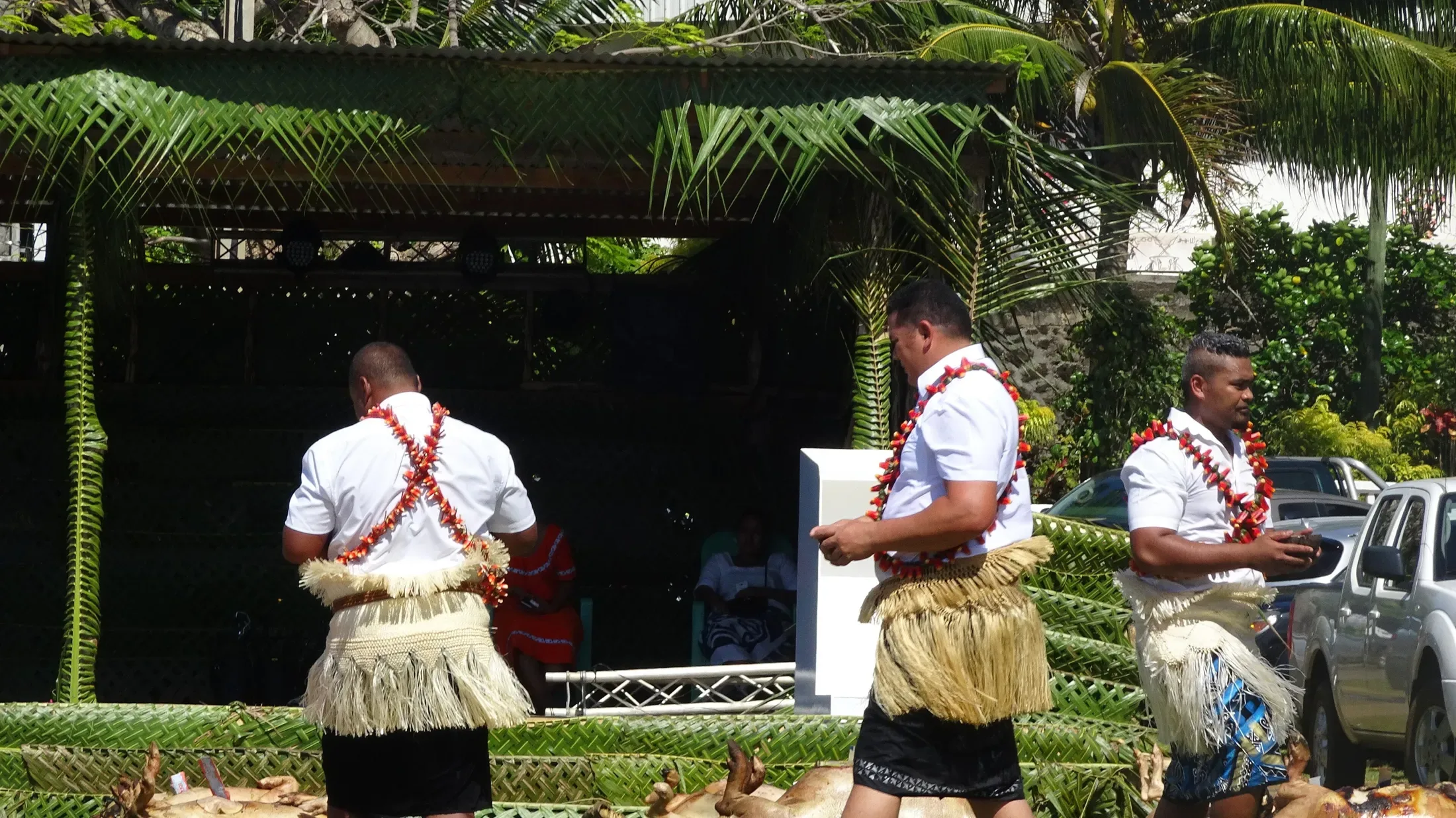
Etiquette in Wallis and Futuna is shaped by the Church and by custom: remove hats and dress appropriately in churches, ask before photographing people, and ask permission before using private beaches or visiting heritage sites. Guide advice is to cover shoulders and knees, and to sit quietly if you are invited to a kava ceremony. Confirm local details with your host or the Territorial Department of Cultural Affairs.
Culture ·
Etiquette in Wallis and Futuna: Dress, Villages and Kava
Etiquette in Wallis and Futuna: dress for church, asking permission, kava and fale manners, photographing people, and what our sources do not say.
01
Dress and the dress code
The tourism board says visitors should remove hats in churches and dress appropriately. A community guide adds, and says to confirm locally, that you should cover shoulders and knees at church and cover swimwear near villages. About 99% of the population is Catholic, so the church sets much of the tone, and modest dress is a courtesy that costs you nothing.
We found no official dress code beyond this, and we cannot tell you what is expected on a Sunday. If in doubt, dress a little more conservatively than you would on the beach.

02
Villages, land and permission
Customary authority is real here. Each king oversees cultural and religious matters and rituals and holds customary authority over land use, and the three kingdoms are Uvea, Sigave and Alo. On Wallis many matters are settled with customary gestures that exchange gifts such as kava root, tobacco or money.
In practice, respect custom (the French phrase is coutumes à respecter) means asking. House-front beaches are privately owned, so ask first. Some heritage sites carry specific customs, such as bans on wearing flower necklaces, so check whether a site is privately owned and whether you need permission. Guide advice is that chiefs almost always grant permission for islets and heritage sites, and that the water-taxi operator on Wallis usually handles it.
03
Kava, fale and the evening gathering
Kava is made from the root and branches of a pepper-family plant and is prepared in a tanoa bowl. It is part of all religious rituals and customary offerings. In Futuna, each village has a tauasu house where men gather each evening to drink kava and settle local matters; the Wallisian equivalent is the faikava.
If you are invited, follow the lead of your hosts. During kava, talking, smoking and moving are forbidden and all observers sit, and customary guards will point out any faux pas. In Futuna women are excluded from the ceremony but may watch, while on Wallis women of certain rank may take part. Guide advice, to confirm locally, is to remove shoes before stepping on the mats of a fale tauasu, sit and wait for introductions, and finish the whole shell.

04
Photographing people
If you search for photographing people in Wallis, the short answer from guide advice is to ask before you photograph people, and that photography is often prohibited at traditional ceremonies. Confirm locally for any ceremony you attend. That is not a licence to photograph anyone you like.

05
Feast days, gifts and dancing
Feast days and large occasions always include mass, and a major feast follows the pattern of mass, then kava, then katoaga gift-sharing, then dances. At a Wallis katoaga the order is early mass, a dignitaries' meal, kava, dances, then distribution of food by rank, with shares announced aloud in descending order.
Spectators reward dancers with banknotes, and money in headdresses is pooled and shared. On 14 July and 29 July a kava ceremony, dances and a mass take place that visitors can join.

06
Language and manners
French is the official language and all three languages, French, Wallisian and Futunan, are in daily use. Few islanders speak English, though tourism professionals mostly do, so a little French is strongly advised. A common Wallisian greeting is "Mālō te maʻuli", often written without macrons.
Sunday is aho tapu, a word missionaries gave a Christian meaning. We have no source on Sunday shop hours or an official Sunday dress code, so ask your host. Inter-island flights do not run on Sundays. If you want to bring kava home, note that it is banned in metropolitan France.
Questions people ask.
- What should I wear in Wallis and Futuna?
- Remove hats in churches and dress appropriately. Guide advice, to be confirmed locally, is to cover shoulders and knees at church and cover swimwear near villages.
- Can I take photos of people in Wallis and Futuna?
- Guide advice is to ask before photographing people, and photography is often prohibited at traditional ceremonies. Confirm locally.
- Can visitors join a kava ceremony?
- On 14 July and 29 July a kava ceremony, dances and a mass take place that visitors can join. During kava, talking, smoking and moving are forbidden, and all observers sit.
- Is it safe and respectful to walk on any beach?
- House-front beaches are privately owned, so ask first. The islands are described as safe and almost free of crime.
- Who can I ask about local customs?
- The Territorial Department of Cultural Affairs, or your host or guesthouse. Guide advice should always be confirmed locally.
Stay on the islands with IMPT.
IMPT (impt.io) is the booking platform behind this site: 8 million hotels and apartments across 195 countries, including the Pacific neighbours of Wallis & Futuna. Stays on Wallis and Futuna themselves are arranged by enquiry with each host. Every stay booked through IMPT supports climate action through the IMPT Climate Contribution programme.
Read next.
The invitation starts here
Be part of the
next chapter.
Join the waitlist First access to stays, routes and launch news.
No spam. Unsubscribe any time.