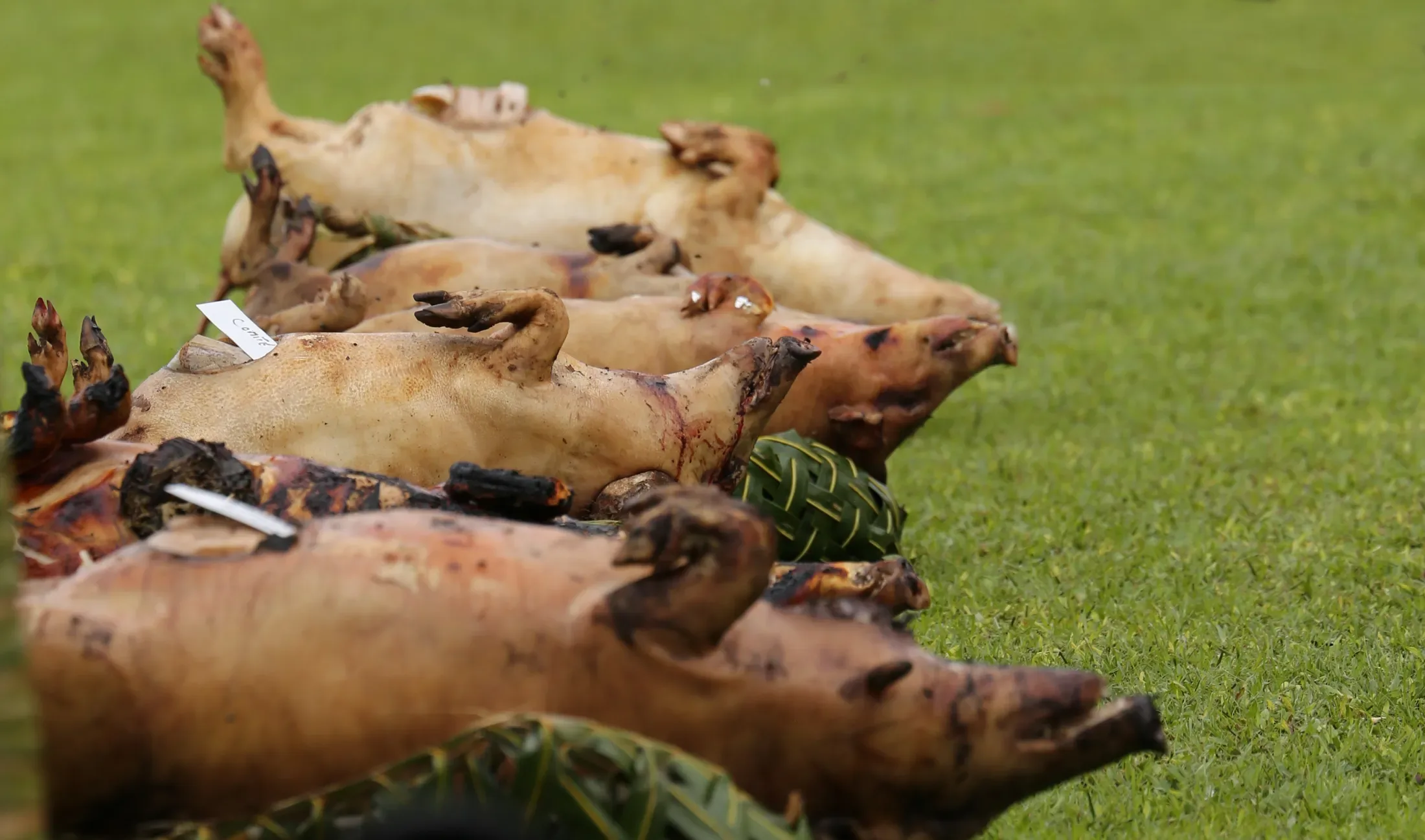
A katoaga is the customary gift-sharing festival of Wallis and Futuna, where pigs, yam and taro baskets, mats, tapa and money envelopes are exchanged and shared out by rank. Katoaga dates are set by custom, not fixed, and none are scheduled for tourists.
Culture ·
Katoaga in Wallis and Futuna: the gift-sharing feast explained
What a katoaga is: the customary gift-exchange feast of Wallis and Futuna, its order of events, when it happens and how a visitor can respectfully see one.
01
What a katoaga is
A katoaga (you will also see katoaga ceremony or katoaga Wallis) is a customary festival built around exchange. Goods such as pigs, baskets of yam and taro, mats, tapa and envelopes of money are presented, and then shared out.
It marks religious feasts, territory holidays, enthronements, weddings, first communions and funerals. In other words, it is the way the community gives weight to its most important moments.

02
How a Wallis katoaga unfolds
On Wallis the order is early mass, a dignitaries' meal, kava, dances, then the distribution of food by rank. Larger pigs go to higher-ranking people, and the shares are announced aloud in descending order.
The tourism board describes the same pattern for any major religious feast: mass, then kava, then katoaga gift-sharing, then dances.

03
Kava, the heart of the ceremony
Kava is made from the root and branches of a pepper-family plant and prepared in a tanoa bowl. It is always performed at the enthroning of a customary king and forms part of all religious rituals and customary offerings.
On Wallis the first cup goes to the Lavelua, the king of Uvea, and the last to the Prefect, with cups alternating between nobles and commoners by rank. Recipients clap three times. During kava, talking, smoking and moving are forbidden and all observers sit, and customary guards will point out any faux pas.
Only men grow and prepare kava, according to the tourism board. On Futuna, women are excluded from the kava ceremony but may watch; on Wallis women of certain rank may take part.
04
Who organises it
Customary ministers, district chiefs and village chiefs set the organisation of a katoaga, and the amount of food is discussed at a fono, a council. On Futuna, each king is assisted by five ministers, and fatogia status, which is village citizenship, brings rights and duties including taking part in katoaga.
Anthropologists consider king an imperfect translation of the Futunan titles sau and hau, which is a reminder that these institutions have their own logic.

05
Money, banknotes and meaning
Spectators reward dancers with banknotes, and money placed in headdresses is pooled and shared. Money collected at a katoaga is typically donated to the Catholic mission or village cooperatives. Banknotes became part of ceremonies such as the katoaga, a change recorded in accounts of the Second World War period on the islands.
One quoted anthropologist compares the gift and counter-gift to a potlatch and says it is not folklore for tourists. That is the right attitude for a visitor. It is a living social system, not a performance.
06
When does a katoaga happen?
Katoaga dates are set by custom, not fixed, and none are scheduled for tourists. We found no official 2026 programme.
The tourism board does say that on Bastille Day (14 July) and the Territory's day (29 July) a kava ceremony, dances and a mass take place that visitors can join. Other feast dates include 28 April for Saint Pierre Chanel, 15 August for the Assumption, when dancers perform, and 11 February for the Loka Cave pilgrimage on Alofi. Ask the Tourist Office what is open to visitors before you plan around any date.

07
How to be a good guest
Do not turn up uninvited at a katoaga. Ask the Tourist Office or your host what is open to visitors and follow their lead.
Sit when others sit and stay quiet during kava. Guide advice, to be confirmed locally, is to ask before photographing people, because photography is often prohibited at traditional ceremonies. If you are offered a drink, take your host's cue. Ask before you offer money.
Questions people ask.
- What is a katoaga?
- A katoaga is a customary festival of Wallis and Futuna in which goods such as pigs, yam and taro baskets, mats, tapa and money envelopes are exchanged and shared out by rank. It marks religious feasts, weddings, funerals and other major events.
- When does a katoaga take place?
- Dates are set by custom, not fixed, and none are scheduled for tourists. Ask the Tourist Office what is open to visitors around the feast days, such as 14 July or 29 July.
- Can tourists attend a katoaga?
- Do not assume so. The tourism board says that on 14 July and 29 July a kava ceremony, dances and a mass take place that visitors can join. For anything else, ask the Tourist Office or your host first.
- What happens at a katoaga on Wallis?
- On Wallis the order is early mass, a dignitaries' meal, kava, dances, then food is distributed by rank. Larger pigs go to higher-ranking people, and the shares are announced aloud.
- Is there a katoaga on Futuna?
- Yes. Futuna also has katoaga, and fatogia status, which is village citizenship, brings the duty and right to take part. Futunan kava follows its own customs, and women watch but do not take part.
Stay on the islands with IMPT.
IMPT (impt.io) is the booking platform behind this site: 8 million hotels and apartments across 195 countries, including the Pacific neighbours of Wallis & Futuna. Stays on Wallis and Futuna themselves are arranged by enquiry with each host. Every stay booked through IMPT supports climate action through the IMPT Climate Contribution programme.
Read next.
The invitation starts here
Be part of the
next chapter.
Join the waitlist First access to stays, routes and launch news.
No spam. Unsubscribe any time.