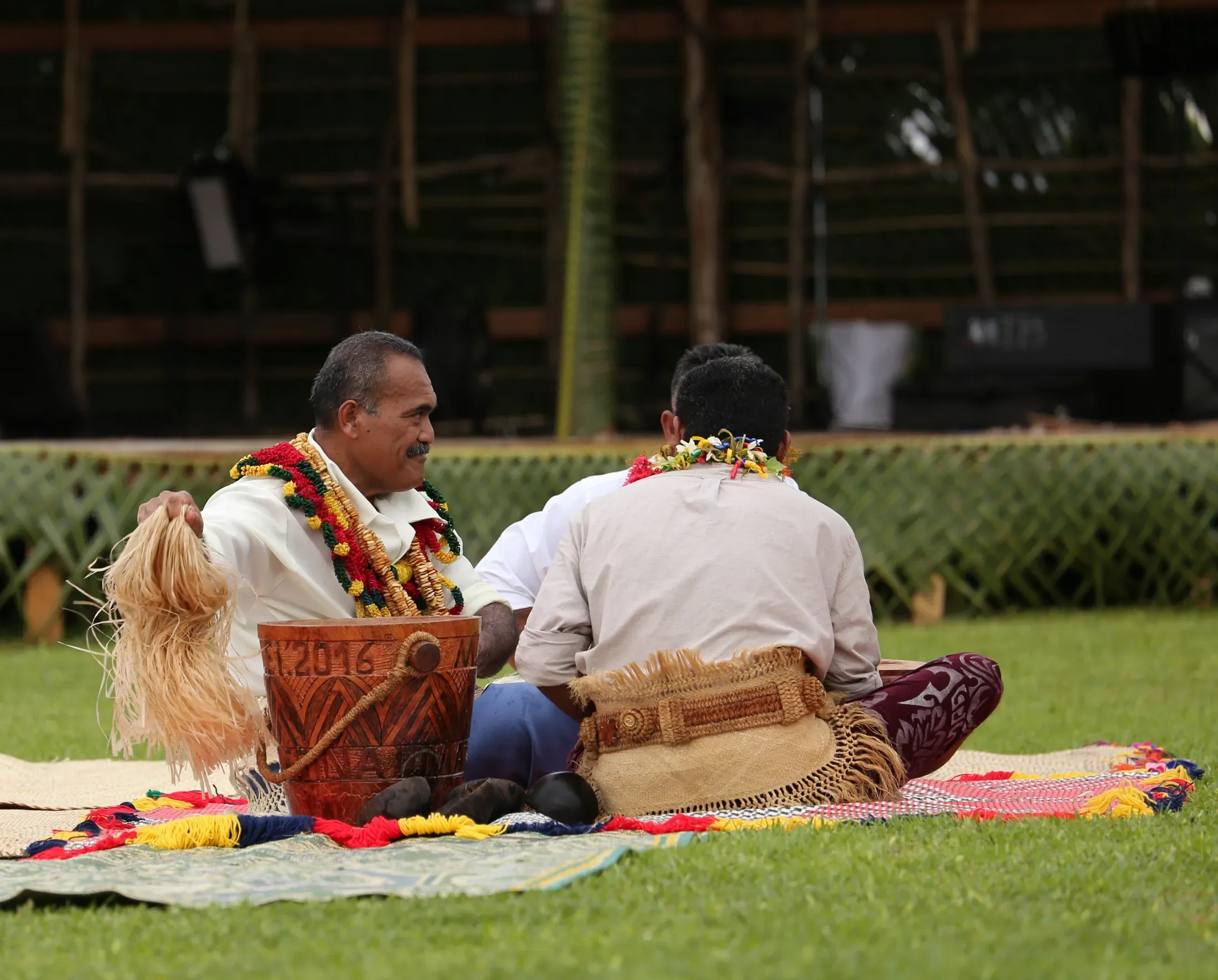
The kava ceremony in Wallis and Futuna is a formal, silent ritual in which a drink made from the root of a pepper-family plant is prepared in a tanoa bowl and served in order of rank. It is always performed when a customary king is enthroned and is part of all religious rituals and customary offerings. Visitors who are invited should sit, stay quiet and follow their hosts.
Culture ·
Kava ceremony in Wallis and Futuna: how it works and etiquette
The kava ceremony in Wallis and Futuna: how it is prepared, who takes part, what visitors should do, and the occasions when you may be able to watch.
01
What kava is and where it fits
Kava is made from the root and branches of a pepper-family plant. It is prepared in a tanoa bowl, and the official territory site says it is always performed at the enthroning of a customary king. It also belongs to all religious rituals and customary offerings.
That makes it more than a drink. On Wallis, many matters are settled with customary gestures that exchange gifts such as kava root, tobacco or money. A major religious feast follows a pattern of mass, then kava, then katoaga gift-sharing, then dances. Those who search for kava Wallis or kava Futuna are really asking about a customary institution, and it is worth approaching it that way.

02
Who prepares it, and who takes part
According to the tourism board, only men grow and prepare kava. In Futuna, women are excluded from the ceremony but may watch; on Wallis, women of certain rank may take part. These are the customs as recorded, and local practice may vary, so follow what your hosts do rather than assuming.
The Wallis and Futuna kava ceremony is organised by rank. On Wallis the first cup goes to the Lavelua, the king of Uvea, and the last to the Prefect, with cups alternating between nobles ('aliki) and commoners (tu'a). Recipients clap three times. In Futuna, everyone present claps when the king drinks.
03
The order of the cups and the legend
The tourism board mentions an Origin of Kava legend in which the first, third and final cups carry special significance. We have not found a source for the details of the legend that we would be confident to repeat, so we leave it there rather than retell a version we cannot check.
After a kava ceremony, the sung segment called lakalaka may honour the king. The kava is a prelude to song and dance as well as to the sharing of food.

04
Etiquette for visitors
The rules are simple and strict. During the ceremony, talking, smoking and moving are forbidden and all observers sit. Customary guards will point out any faux pas, so there is no need to worry about learning every detail, but do take the instruction seriously. Do not stand or move around while the kava is served.
Guide advice, which you should confirm locally, adds a few points for kava etiquette Wallis visitors often ask about: remove your shoes before stepping on the mats of a fale tauasu, sit and wait for introductions, and finish the whole shell. Ask before photographing people, because photography is often prohibited at traditional ceremonies. Visitors should also dress appropriately and remove hats in churches.
05
Everyday kava: the tauasu and the faikava
In Futuna, each village has a tauasu house, called a fale tauasu, where men gather each evening to drink kava and settle local matters. The Wallisian equivalent is the faikava.
The evening kava is a social setting rather than a show for visitors. If you would like to attend, ask your host or lodging for an introduction rather than turning up, and accept that you may be asked to observe from the edge.

06
When visitors can see a ceremony
On Bastille Day (14 July) and the Territory's day (29 July), a kava ceremony, dances and a mass take place that visitors can join. The official programme for 2026 is not in our records, so ask the tourism office for dates before planning your trip around them.
Kilikiti, the local cricket, is preceded by a night-time kava ceremony, and on the eve of a match village groups visit the chiefs with kava for advice and blessing. These are community occasions, so treat them with the same respect as any other ceremony.
Finally, if you wish to take kava home, note that it is banned in metropolitan France. Check customs rules for your own destination before you pack any.
Questions people ask.
- What is the kava ceremony in Wallis and Futuna?
- It is a formal ritual in which a drink made from the root of a pepper-family plant is prepared in a tanoa bowl and served in order of rank. It is always performed at the enthroning of a customary king and is part of religious rituals and customary offerings.
- Can visitors attend a kava ceremony?
- Visitors can join the kava ceremony held on Bastille Day (14 July) and Territory Day (29 July). For other ceremonies, wait for an invitation and follow your host. Confirm dates with the tourism office.
- Can women take part in kava?
- Only men grow and prepare kava, according to the tourism board. In Futuna women are excluded from the ceremony but may watch; on Wallis women of certain rank may take part.
- What should I not do during a kava ceremony?
- Do not talk, smoke or move around, and stay seated. Customary guards will point out any faux pas. Ask before taking photographs, as photography is often prohibited.
- Can I bring kava home to France?
- No. Kava is banned in metropolitan France, which matters if you plan to bring any home from the islands.
Stay on the islands with IMPT.
IMPT (impt.io) is the booking platform behind this site: 8 million hotels and apartments across 195 countries, including the Pacific neighbours of Wallis & Futuna. Stays on Wallis and Futuna themselves are arranged by enquiry with each host. Every stay booked through IMPT supports climate action through the IMPT Climate Contribution programme.
Read next.
The invitation starts here
Be part of the
next chapter.
Join the waitlist First access to stays, routes and launch news.
No spam. Unsubscribe any time.