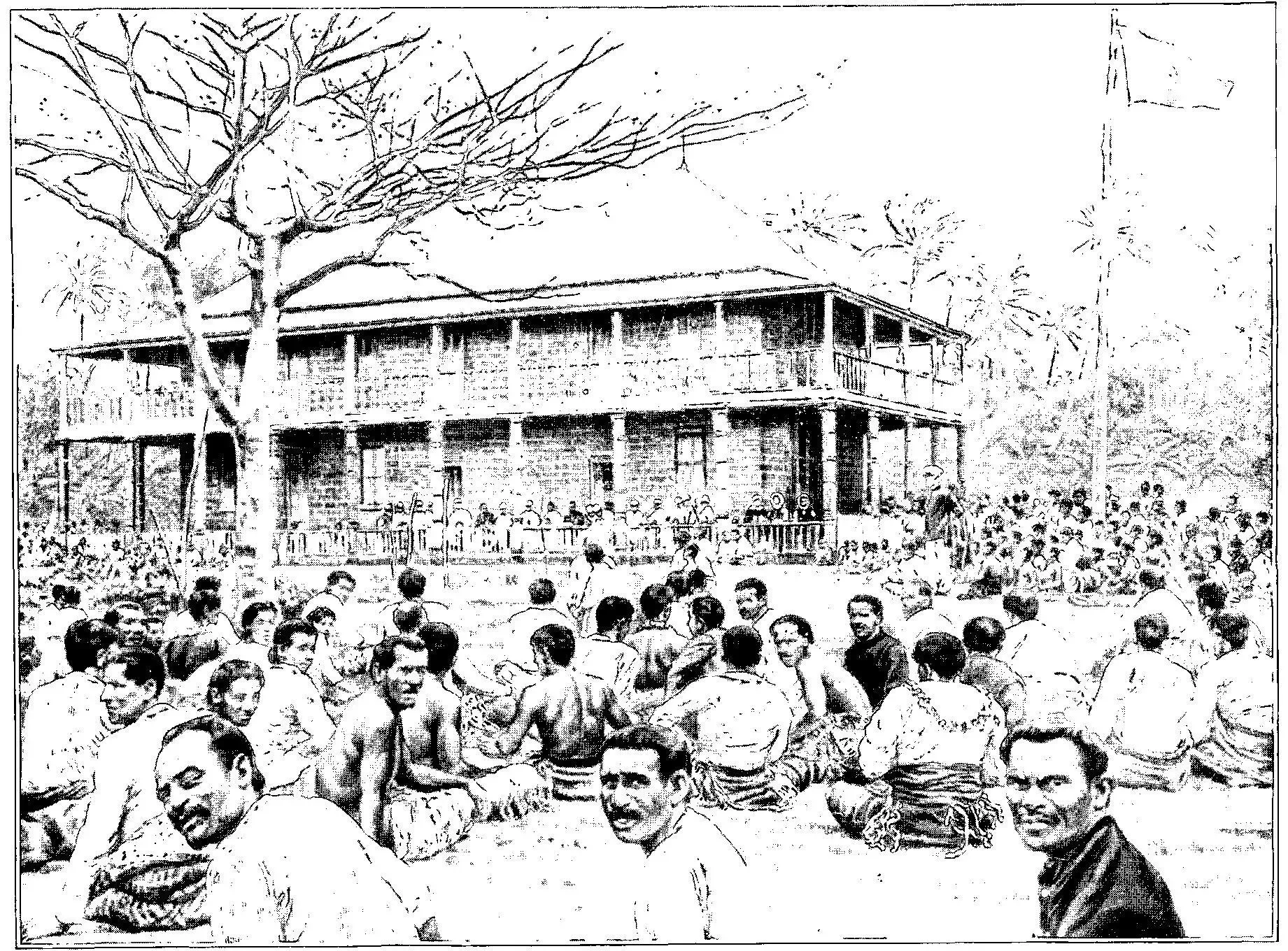
The kings of Wallis and Futuna rule three customary kingdoms: Uvea, which covers all of Wallis, and Sigave and Alo on Futuna. They sit alongside French administration rather than replacing it. The 1961 statute recognises the kings' authority and powers, and the State pays them an allowance.
Culture ·
Kings of Wallis and Futuna: The Three Customary Kingdoms
The kings of Wallis and Futuna: three customary kingdoms, the Lavelua of Uvea, the kings of Sigave and Alo, and how custom works alongside French rule.
01
The three kingdoms
There are three customary kingdoms. Uvea covers all of Wallis, Sigave covers north-west Futuna, and Alo covers south-east Futuna and Alofi. Each has its own king: Uvea's king holds the title Lavelua and its capital is Mata'Utu, Sigave's king is the Tu'i Sigave with Leava as capital, and Alo's king is the Tu'i Agaifo.
Uvea has 21 villages in three districts, Hihifo, Hahake and Mu'a. Alo has 9 villages and Sigave 6. Custom is organised around these three kingdoms.

02
The Lavelua and the court of Uvea
The Lavelua is assisted by a prime minister, called the Kalae Kivalu, together with customary ministers and village chiefs. Faipule are district chiefs and pula kolo are village chiefs. If you are searching for the Wallis king (roi de Wallis), this is the title you are looking for.
Tomasi Kulimoetoke II, who lived from 26 July 1918 to 7 May 2007, was the 50th Lavelua, elected on 12 March 1959. The territory's status was set by law no. 61-814 of 29 July 1961, after the referendum of 27 December 1959. After his death a six-month mourning period followed, during which it was taboo to mention a successor.
03
Kings on Futuna
On Futuna each king is assisted by five ministers, the Aliki Fa'u, and a police chief. Custom, known as Aga'ifenua, is central to daily life, and local fono councils handle civil and customary justice. Anthropologists consider king an imperfect translation of the Futunan titles sau and hau.
Futuna's ruling lines have their own origin stories. The line of Alo is traditionally said to descend from Samoa, from the Fakavelikele lineage, with a peaceful arrival in oral tradition. Anakele on Futuna is the burial site of King Fakavelikele and the origin of the current Tu'i Agaifo dynasty.

04
How a king is chosen
Kingship is not simply hereditary. Royal families negotiate the choice, sometimes over months.
Each king oversees cultural and religious matters and rituals, and holds customary authority over land use. Kava is always performed at the enthroning of a customary king.
05
Kings and the French state
Queen Amelia reigned over Uvea from 1869 to 1895, converted to Catholicism and had a royal palace and a cathedral built at the capital. She sent a protectorate request to France on 19 November 1886, and France ratified the treaty for Uvea on 5 April 1887. The kings of Sigave and Alo asked to join on 29 November 1887, and the protectorate was extended to Futuna on 16 February 1888.
The territory ceased to be a protectorate in 1961 when law no. 61-814 of 29 July set its status, and it became an overseas collectivity on 28 March 2003. Today the statute acknowledges the kings' authority, and the State pays an allowance.

06
What a visitor can see
The Cathedral of Our Lady of the Assumption at Mata'Utu was built from 1952 to 1959 in blue volcanic stone and has a royal tomb inside. On Bastille Day, 14 July, and Territory Day, 29 July, a kava ceremony, dances and a mass take place that visitors can join. Katoaga gift-sharing festivals follow custom rather than a tourist calendar, and none are scheduled for visitors.
On Wallis the first cup of kava goes to the Lavelua and the last to the Prefect, and cups alternate between nobles and commoners by rank. During kava, talking, smoking and moving are forbidden and all observers sit.
Questions people ask.
- How many kings are there in Wallis and Futuna?
- There are three customary kings, one for each kingdom: the Lavelua of Uvea on Wallis, the Tu'i Sigave and the Tu'i Agaifo on Futuna.
- What does Lavelua mean?
- Lavelua is the title of the king of Uvea, the customary kingdom covering all of Wallis. Its capital is Mata'Utu.
- Do the kings have official power?
- The 1961 statute recognises the kings' authority and powers, and the State pays them an allowance. Each king oversees cultural and religious matters and customary authority over land use.
- Can visitors take part in royal ceremonies?
- On Bastille Day and Territory Day a kava ceremony, dances and a mass take place that visitors can join. Katoaga festivals follow custom and none are scheduled for tourists, so ask locally.
Stay on the islands with IMPT.
IMPT (impt.io) is the booking platform behind this site: 8 million hotels and apartments across 195 countries, including the Pacific neighbours of Wallis & Futuna. Stays on Wallis and Futuna themselves are arranged by enquiry with each host. Every stay booked through IMPT supports climate action through the IMPT Climate Contribution programme.
Read next.
The invitation starts here
Be part of the
next chapter.
Join the waitlist First access to stays, routes and launch news.
No spam. Unsubscribe any time.