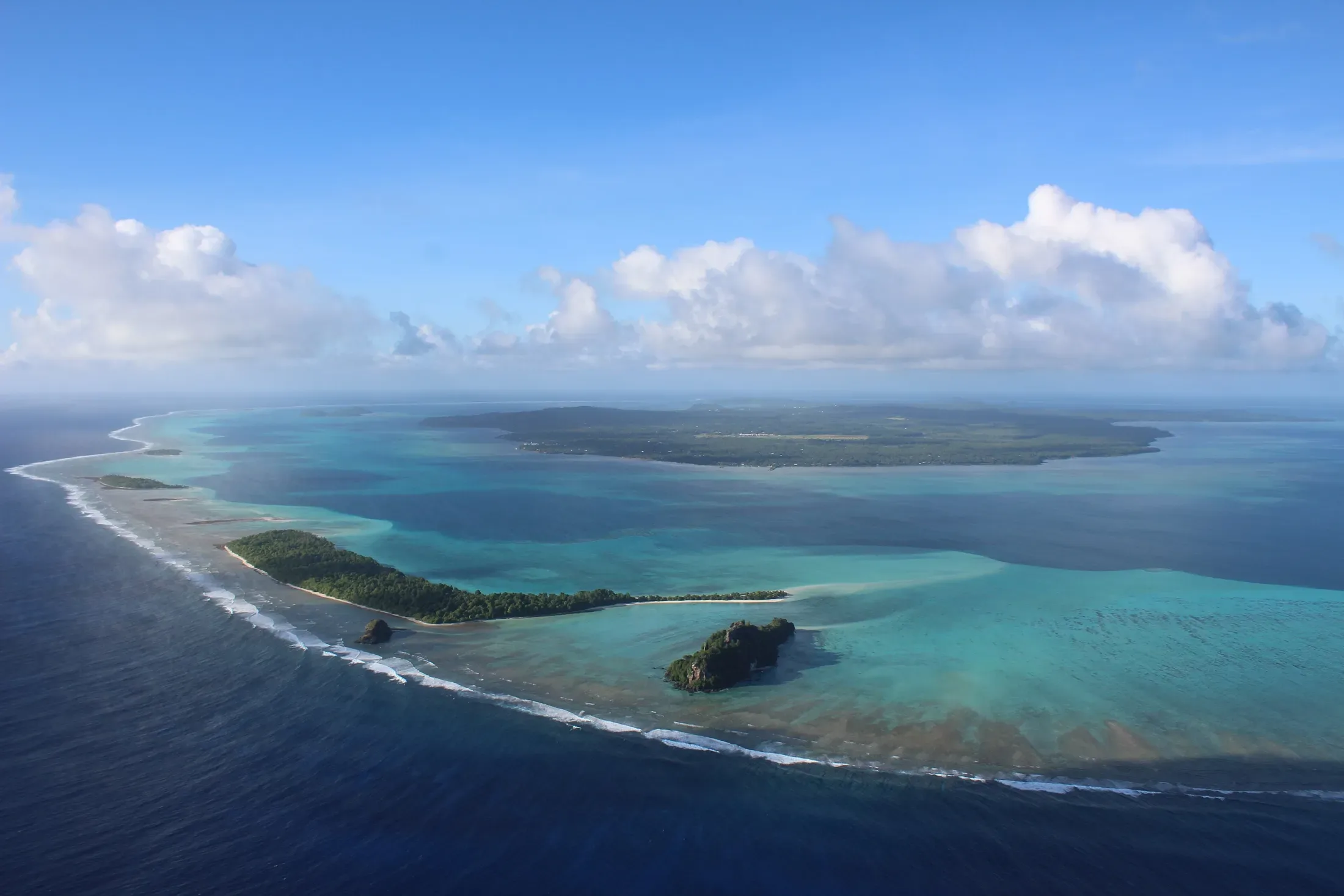
The best things to do in Wallis are the lagoon and its islets, the crater lakes (above all Lalolalo), the Tongan fort at Talietumu, the churches of Mata'Utu and the wartime remains. A drive around the island is about 35 km, so you can see much of it in a day. You need a hire car, because Wallis has no public transport and no taxis.
Things to do ·
Things to do in Wallis: lagoon, lakes, forts and churches
Things to do in Wallis: a barrier-reef lagoon with islets, crater lakes, the Talietumu fort, churches and WWII sites, plus a one-day plan and honest caveats.
01
The lagoon and its islets
Among the Wallis island attractions, the lagoon comes first. Wallis (Uvea) is encircled by a lagoon and a barrier reef. The reef is 4 to 5 km wide, and the lagoon holds more than a dozen uninhabited islets, called motu. Visitors reach them by taxi boat or by kayak from the Vakala watersports centre at Liku. Before you go, check with the Tourist Office about protected areas and rules for the islets.
The sea life listed by the tourism board includes hawksbill turtles, spotted eagle rays, sharks, parrotfish and Napoleon fish, plus dolphins. Humpback whales and pygmy killer whales may be seen in late summer or early autumn, with no certainty. Gahi Bay is the only authorised anchorage on Wallis and has the taxi-boat pier. Names of islets given on operator pages include Faioa, Fenuafoou and Nukuatea.

02
Crater lakes, above all Lalolalo
Wallis was shaped by volcanic activity, which left crater lakes including Lalolalo, Kikila, Alofivai and Lanutavake. The island has no streams, so these lakes are its main freshwater reserves. Lalolalo is the largest in the territory, in the southwest of Wallis, off Route 1 between Mala'etoli and Ahoa. It is a nearly circular crater roughly 400 to 500 m across and at least 80 m deep, with sheer rock walls. A lookout gives a view of the whole lake, and flying foxes and tropical birds live in the forest around it.
The lake is also remarkable below the surface. It is fresh at the top but reaches 31 ppt salinity at the bottom, with no oxygen below 10 m, and a 2011 research team reported blind white eels. Lalolalo features in local mythology and, in the war years, the road cut through the forest regarded as sacred around it.

03
Talietumu, the Tongan fort
Talietumu, also called Kolo Nui, lies in the Mua district about 9 km southwest of Mata'Utu. It is a fortified Tongan settlement built around 1450 and the last Tongan holdout on the island. A basalt wall with several entrances surrounds a central platform about 5 m high and 80 m long, with stone-paved walkways. French archaeologists restored the platform with original techniques, finishing around 1997. The tourism board calls it one of the largest walled complexes in the Pacific, and it is worth the detour. Some heritage sites have specific customs, so check whether permission is needed before you enter.

04
Churches, Mata'Utu and the war
Mata'Utu, the capital, has the Cathedral of Our Lady of the Assumption, built from 1952 to 1959 in blue volcanic stone with two towers. It holds a royal tomb. Elsewhere on the island, the Lano chapel at Alele, blessed in 1877, has a roof decorated with tapa panels, and the stone church of Saints Peter and Paul at Vaitupu dates from 1865-66. Remove your hat in churches and dress appropriately.
American forces arrived in late May 1942 and about 6,000 were stationed here at the peak. They built the Hihifo airfield, which is today's airport, a hydrobase at Mu'a Point, the port at Gahi, a 70-bed hospital and roads. The Uvea Museum Association runs a museum in Mata'Utu, opened in 2006, dedicated to the war on Wallis, and the board's On the American Trail tour includes US bunkers.

05
Sunset, sport and the air
Mont Lulu, at about 150 m the highest point of Wallis, has a chapel favoured as a sunset viewpoint. Vailala beach in the north, which has fine white sand, and Lausikula beach in the south are also sunset spots. For activities, the board lists a dive centre at Halalo, kitesurfing at Falaleu, and ultralight flights over land and lagoon from Hihifo airfield, best at low tide for blue tones. About ten traditional sailing canoes still sail the northern lagoon, and sailing on them is open to tourists.
06
A one-day plan
For Uvea sightseeing in a single day, or if you are asking que faire à Wallis, this order works. Start in Mata'Utu with the cathedral, then drive south to Talietumu. Continue to Lake Lalolalo for the lookout, then spend the afternoon on the lagoon coast, or book a taxi boat to an islet if you have arranged it in advance. Finish at Mont Lulu or Lausikula beach for sunset. Check any opening times, boat bookings and prices locally, as the records give none we can vouch for.
Ask the Tourist Office for current details, and ask before you swim from a beach in front of a house, as those belong to the owner.
Questions people ask.
- What are the main things to do in Wallis?
- The lagoon and its islets, the crater lakes such as Lalolalo, the Talietumu fort, the Mata'Utu cathedral and other churches, and sunsets from Mont Lulu. The board also lists diving, kitesurfing and ultralight flights.
- How do you get around Wallis?
- By hire car. There is no public transport and there are no taxis. Traffic drives on the right, and a coastal drive round the island is about 35 km.
- Can you visit the islets in the Wallis lagoon?
- Yes, by taxi boat or by kayak from the Vakala watersports centre. Check with the Tourist Office about protected areas and rules before you go.
- Is Wallis safe for visitors?
- The tourism board describes the islands as safe and almost free of crime, and says Wallis has no snakes or dangerous predators. The UK government advises that most visits are trouble-free.
Stay on the islands with IMPT.
IMPT (impt.io) is the booking platform behind this site: 8 million hotels and apartments across 195 countries, including the Pacific neighbours of Wallis & Futuna. Stays on Wallis and Futuna themselves are arranged by enquiry with each host. Every stay booked through IMPT supports climate action through the IMPT Climate Contribution programme.
Read next.
The invitation starts here
Be part of the
next chapter.
Join the waitlist First access to stays, routes and launch news.
No spam. Unsubscribe any time.