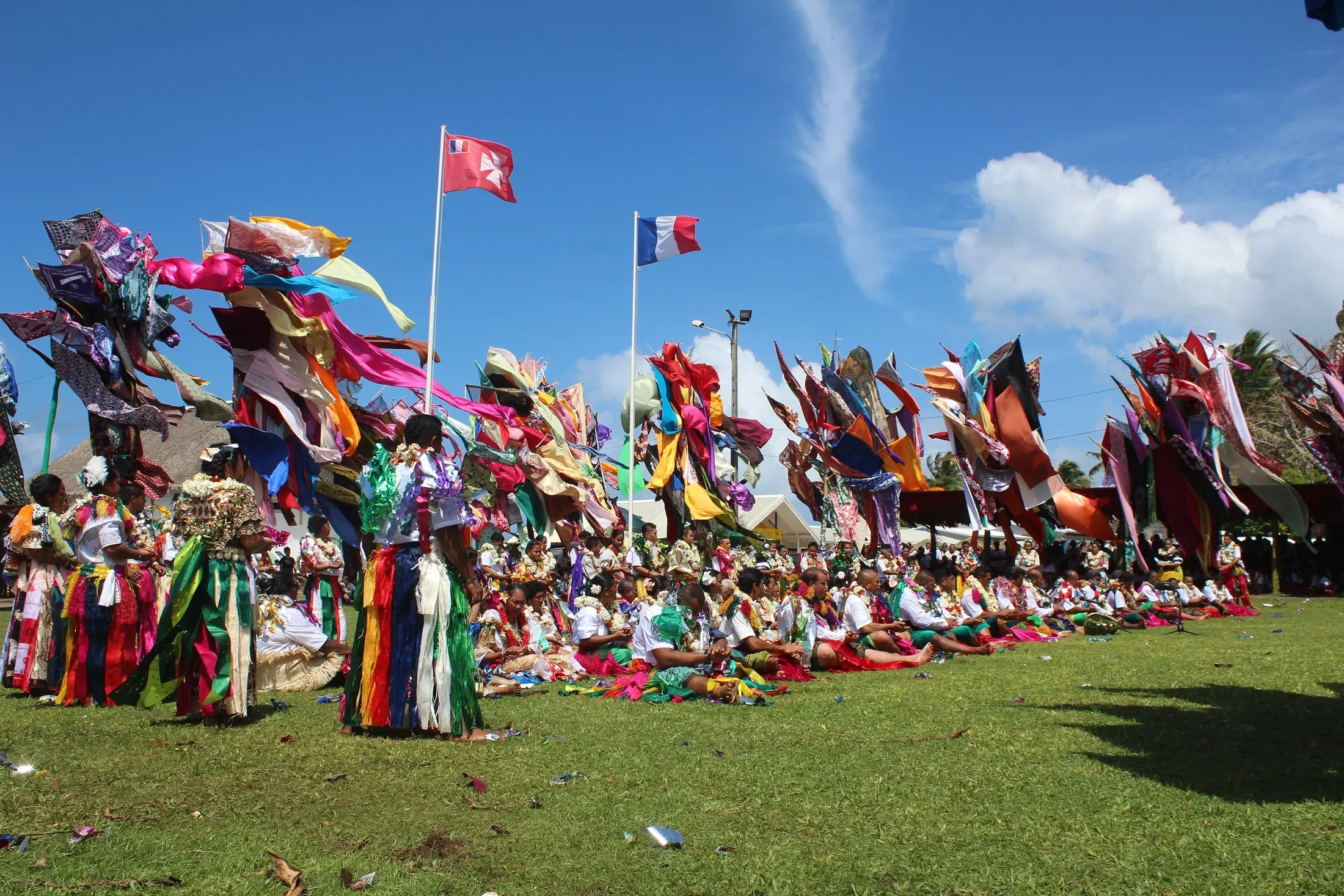
Traditional dance in Wallis and Futuna comes in at least 16 types, called faive, which vary by place, occasion, performers and instruments. Most include singing and percussion, while the kailao club dance has no song. Visitors can see dances at feasts such as the Territory's day, Bastille Day and the Assumption on 15 August.
Culture ·
Traditional Dance in Wallis: Kailao, Tapaki and More
Traditional dance Wallis style: kailao, tapaki, eke, sasa, lakalaka and soamako explained, with the feasts where visitors can watch and how to behave.
01
A dance for every occasion
Wallis dances (danse wallisienne) are not a single performance style. The tradition counts at least 16 dance types, and they differ according to where they are danced, what is being marked, who performs and which instruments are used. Most combine singing with percussion, and the kailao is the notable exception, danced without a song.
Dance sits inside a wider pattern of customary life. At a major religious feast the order is mass, then kava, then the gift-sharing called katoaga, then dances. Think of dance as one part of a day in which the whole community takes part, rather than a show laid on at a set time.

02
The main dances
Kailao is a club dance in which two groups of men approach from opposite sides of the mala'e, the ceremonial ground. Its rhythm comes from a pate gong or even a kerosene tin. Tapaki, also written tu'upaki, is a paddle dance that honours a chief and ancestors, and is said to have originated in Futuna. In Futuna it is danced by men only, while on Uvea women may join, so a Futuna dance can look quite different from a Wallis one.
Eke is a stick dance performed in pairs. Sasa is a seated dance borrowed from Samoa, led by the pulotu. Niutao, or fakaniutao, is based on the Tuvaluan fatele but more graceful. Soamako is informal and accelerating, with a chorus, drums, guitars, ukuleles and the nafa.
Lakalaka is a sung segment honouring the king or following a kava ceremony, and its first stanza greets the king and chiefs. If you are searching for lakalaka Wallis, expect a song before the dance and a link with the kava ceremony and royal occasions. You may also see tau'olunga named in searches. Our sourced records do not describe it, so we leave it out.

03
Sound and instruments
Traditional instruments include slit gongs (lali), rolled mats (fala), sounding boards, Jew's harps (utete), flutes, shell trumpets and leaf oboes. In the informal soamako, modern instruments such as guitars and ukuleles join the drums.
Songs matter as much as steps. Funeral songs (hiva mate) are composed and performed weeks or months after a death, and hiva lausiva greet the king and chiefs before major events. Evening tales, called fagana, are told by grandparents.
04
Costume and craft
Dance dress belongs to the wider craft tradition of the islands.
Behind such costumes sits a wider craft tradition. Giant tapa, called gatu in Wallisian and siapo in Futunan, is made by women from beaten paper mulberry bark and offered at customary and religious ceremonies. The ta'ovala waist cloth is worn only on Wallis, at customary and religious ceremonies or when presenting to the king. Tiare flower necklaces signal welcome, and a visitor may be offered one.

05
Where visitors can watch
The tourism site says a kava ceremony, dances and a mass take place on Bastille Day (14 July) and on the Territory's day (29 July), and that visitors can join. On 15 August, dancers perform at the Assumption festival, and 28 April, Saint Pierre Chanel's day, is marked by pilgrimage to Poi.
There is also a katoaga, the customary festival where goods such as pigs, yam and taro baskets, mats and tapa are exchanged. Katoaga dates are set by custom, not fixed, and none are scheduled for tourists. We found no official programme for 2026, so ask the Tourist Office what is planned. In Nouméa, a Wallis and Futuna festival is held annually.

06
Watching with respect
One quoted anthropologist calls the katoaga not folklore for tourists. Treat it as the community's own occasion and behave as a guest rather than an audience. Ask before photographing people: photography is often prohibited at traditional ceremonies, so confirm locally.
During kava, talking, smoking and moving are forbidden and observers sit, and customary guards will point out any faux pas. Spectators reward dancers with banknotes, and money in headdresses is pooled and shared, so ask a local how and when this is done. Remove hats in churches and dress appropriately.
Questions people ask.
- What are the main traditional dances of Wallis and Futuna?
- Kailao, tapaki, eke, sasa, lakalaka, soamako and niutao are the ones our records describe. There are at least 16 types, called faive, varying by place and occasion.
- Where can I see Wallis dances?
- Dances accompany feasts such as Bastille Day, the Territory's day and the Assumption on 15 August. Katoaga dates are not scheduled for tourists, so ask the Tourist Office.
- Which dance comes from Futuna?
- Tapaki, the paddle dance honouring a chief and ancestors, is said to have originated in Futuna. In Futuna it is danced by men only.
- Can I take photos of the dances?
- Ask before photographing people. Photography is often prohibited at traditional ceremonies, so confirm locally on the day.
Stay on the islands with IMPT.
IMPT (impt.io) is the booking platform behind this site: 8 million hotels and apartments across 195 countries, including the Pacific neighbours of Wallis & Futuna. Stays on Wallis and Futuna themselves are arranged by enquiry with each host. Every stay booked through IMPT supports climate action through the IMPT Climate Contribution programme.
Read next.
The invitation starts here
Be part of the
next chapter.
Join the waitlist First access to stays, routes and launch news.
No spam. Unsubscribe any time.