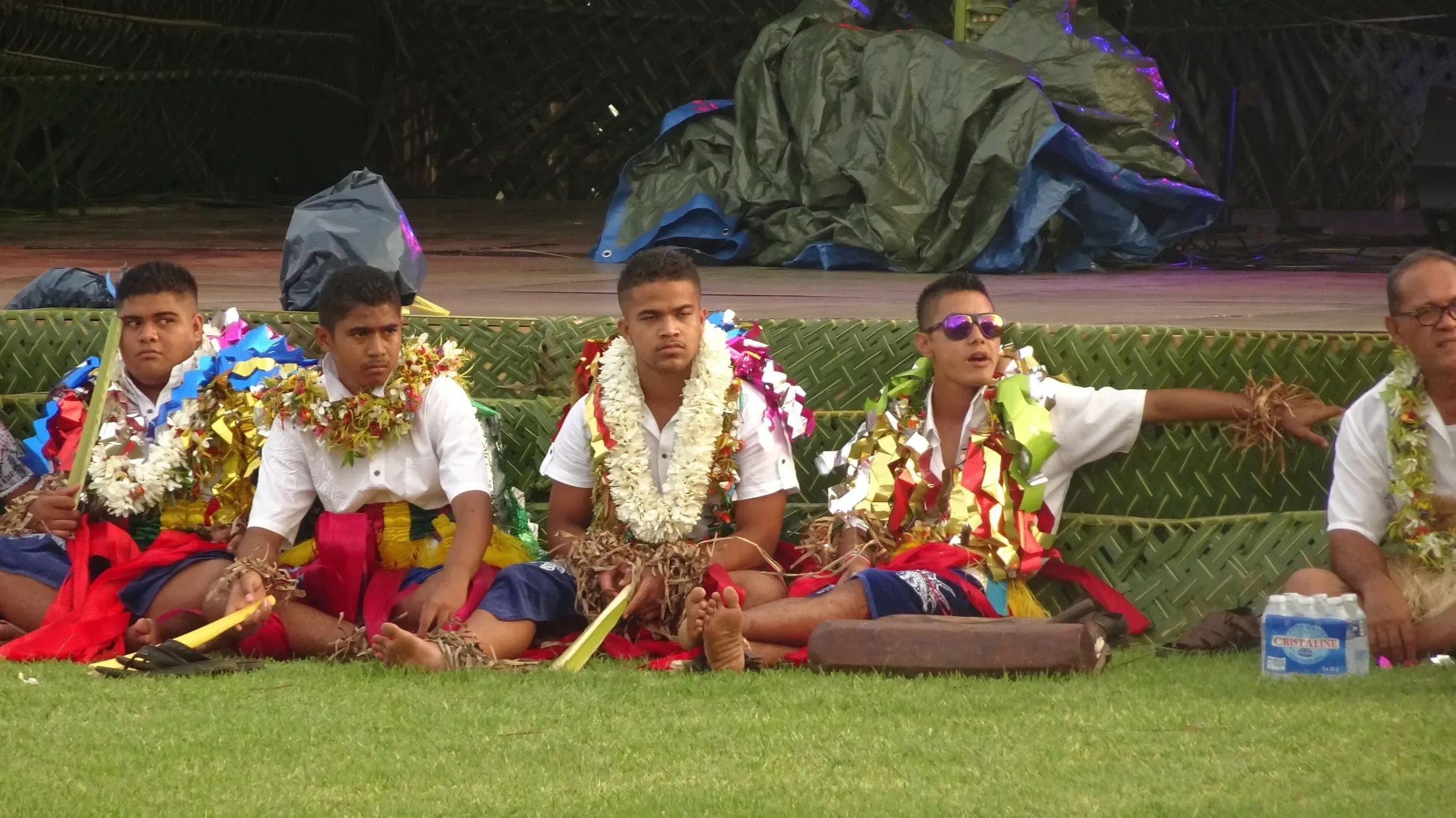
Wallis and Futuna culture is Polynesian, organised around three customary kingdoms, the Catholic Church, the kava ceremony and the gift exchange called katoaga. Custom and faith are woven together here: about 99% of the population is Catholic, and kings still hold customary authority. As a visitor you will mostly meet this culture through feast days, churches, crafts and everyday courtesy.
Culture ·
Wallis and Futuna culture: custom, Church, kava and kin
Wallis and Futuna culture rests on three customary kingdoms, the Catholic Church, kava and katoaga gift exchange. A respectful guide to customs and etiquette.
01
Three kingdoms, one territory
There are three customary kingdoms: Uvea, which is all of Wallis, Sigave in north-west Futuna, and Alo in south-east Futuna and Alofi. Uvea's king holds the title Lavelua, Sigave's is the Tu'i Sigave and Alo's is the Tu'i Agaifo. Uvea has 21 villages in three districts, Hihifo, Hahake and Mu'a, with Mata'Utu as its capital. The Lavelua is assisted by a prime minister, customary ministers and village chiefs.
Kingship is not simply hereditary: royal families negotiate the choice, sometimes over months. The 1961 statute recognises the kings' authority and powers, and each king oversees cultural and religious matters and holds customary authority over land use. Anthropologists consider king an imperfect translation of the Futunan titles. On Futuna, local fono (council) courts handle civil and customary justice.
02
Language and kinship
French is the official language, but the home language in 2023 was Wallisian for 57.3% of people, Futunan for 28.2% and French for 14.3%. Wallisian is closely related to Tongan and has honorific, commoner and vulgar registers. Futunan is classed as endangered, with about 2,500 native speakers. Wallisian culture and Futunan culture (culture Wallis et Futuna, in French) are not identical: Wallis changed more than Futuna in society, language and culture, and Futuna's language and culture are more Samoan, although it is closer to Tonga. Some French helps, since few islanders speak English, though tourism professionals mostly do.
Families control marriages and the Church sanctions them, and both sons and daughters inherit land rights. On Wallis, many matters are settled with customary gestures that exchange gifts such as kava root, tobacco or money. On Futuna, custom (Aga'ifenua) is central to daily life.
03
Faith and feast days
Catholicism is central. The diocese has its seat at Mata'Utu, and feast days and large occasions always include mass. Any major religious feast follows a pattern: mass, then kava, then katoaga gift-sharing, then dances. Pilgrimages mark the year, notably 28 April at Poi, on Futuna, for Saint Pierre Chanel, and the Assumption festival on 15 August, when dancers perform.
In churches, visitors should remove hats and dress appropriately. One guide adds that you should cover shoulders and knees, but that is guide advice to confirm locally.

04
Kava
Kava is made from the root and branches of a pepper-family plant, prepared in a tanoa bowl, and it is always performed at the enthroning of a customary king. It is part of all religious rituals and customary offerings. On Wallis the first cup goes to the Lavelua, and cups alternate between nobles and commoners by rank. During the ceremony, talking, smoking and moving are forbidden and observers sit.
On Futuna, men gather each evening in the village tauasu house to drink kava and settle local matters, and women are excluded from the ceremony but may watch. On Wallis, women of certain rank may take part. If you are invited, follow your host. Guides advise removing shoes before stepping on the mats and finishing the whole shell, but those are community tips to check on the spot.

05
Katoaga, the gift exchange
Katoaga is a customary festival where goods such as pigs, yam and taro baskets, mats, tapa and money envelopes are exchanged. It marks religious feasts, territory holidays, enthronements, weddings, first communions and funerals. At a Wallis katoaga, the order is early mass, a dignitaries' meal, kava, dances, then distribution of food by rank, with shares announced aloud. One quoted anthropologist calls it not folklore for tourists, which is a good reminder that this is a living practice. Dates are set by custom, and none are scheduled for tourists.

06
Crafts, dance and sport
Giant tapa, called gatu in Wallisian and siapo in Futunan, is made by women from beaten paper mulberry bark, and cloths can be 100 m or more. Mats are called fala and are woven from leaves. Tiare flower necklaces signal welcome. There are at least 16 dance types, called faive, and kailao is a club dance performed by two men's groups. Kilikiti, the Wallisian cricket, is the archipelago's emblematic sport, played mainly at big festivities such as 14 July and 29 July.

07
Visiting well
Ask before photographing people, because photography is often prohibited at traditional ceremonies (guide advice, confirm locally). Beaches in front of houses belong to the owner, so ask first. The Territorial Department of Cultural Affairs can advise about customs.
Questions people ask.
- What is the main religion in Wallis and Futuna?
- Roman Catholicism. About 99% of the population is Catholic, the diocese has its seat at Mata'Utu, and feast days always include mass.
- Does Wallis and Futuna have kings?
- Yes, three customary kings: the Lavelua of Uvea, the Tu'i Sigave and the Tu'i Agaifo. The 1961 statute recognises their authority, and they oversee cultural and religious matters and customary land use.
- What is katoaga?
- A customary festival of gift exchange, where pigs, taro, mats, tapa and money are given by rank. It accompanies feasts, weddings, funerals and enthronements. Its dates are set by custom, not for tourists.
- What languages are spoken in Wallis and Futuna?
- French is official, and Wallisian and Futunan are in daily use. Few islanders speak English, though tourism professionals mostly do.
Stay on the islands with IMPT.
IMPT (impt.io) is the booking platform behind this site: 8 million hotels and apartments across 195 countries, including the Pacific neighbours of Wallis & Futuna. Stays on Wallis and Futuna themselves are arranged by enquiry with each host. Every stay booked through IMPT supports climate action through the IMPT Climate Contribution programme.
Read next.
The invitation starts here
Be part of the
next chapter.
Join the waitlist First access to stays, routes and launch news.
No spam. Unsubscribe any time.